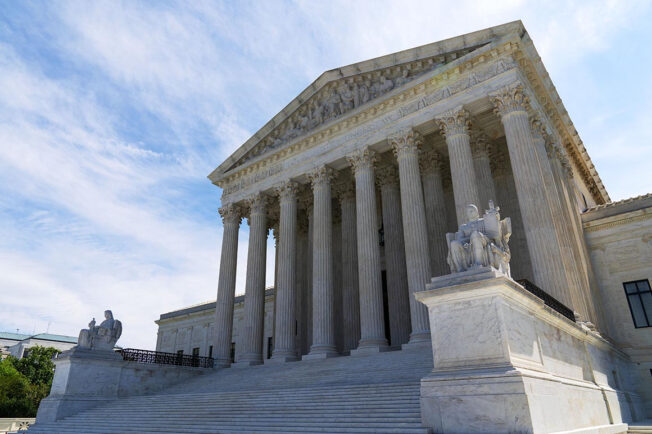
The U.S. Supreme Court only rarely agrees to take up consideration of cases involving securities law issues, so it was a noteworthy event when the Court agreed late last week to take up a case involving the SEC’s enforcement powers. As discussed below, the case involves questions of what the SEC has to prove in order to secure disgorgement from alleged wrongdoers. The Court’s ruling in the case, which is captioned Sripetch v. SEC, will address a split in the Circuit Courts on the question of whether the SEC must prove that investors were harmed by the wrongdoers’ acts in order to obtain disgorgement.Continue Reading Supreme Court Agrees to Consider SEC’s Disgorgement Remedy Rights


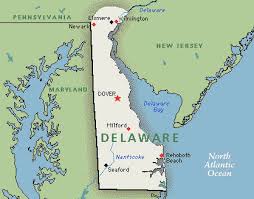 In the latest development a long-running D&O insurance coverage dispute, a Delaware Court has held that Verizon’s D&O insurance program covers the company’s $95 million settlement of a bankruptcy Trustee’s fraudulent transfer claim. In reaching this conclusion, the Court held, among other things, that the fraudulent transfer claim was a “Securities Claim” within the meaning of Verizon’s primary D&O insurance policy. The specifics of the court’s analysis of this issue underscores how complicated the question of what constitutes a “Securities Claim” can be. A copy of Delaware Superior Court Judge Eric Davis’s October 20, 2022 opinion can be found
  Yet another Delaware court has issued a noteworthy management liability insurance coverage opinion. In a detailed September 12, 2022 opinion in a dispute between Godiva Chocolatier and its management liability insurers over coverage for underlying consumer protection claims against the company, Delaware Superior Court Judge Mary M. Johnston rejected many – but not all — of the insurers’ coverage defenses. A copy of Judge Johnston’s opinion can be found
 In the following guest, Yaminah Williams, Assistant Vice President, Hiscox USA, Alicia Garcia, Claims Counsel, Hiscox USA, Katherine Hausmann, Senior Complex Claims Specialist, Hiscox USA, Elan Kandel, Member, Bailey Cavalieri LLC and James Talbert, Associate, Bailey Cavalieri LLC, review the key 2001 D&O insurance coverage decisions. I would like to thank the authors for allowing me to publish their article as a guest post on this site. I welcome guest post submissions from responsible authors on topics of interest to this blog’s readers. Please contact me directly if you would like to submit a guest post. Here is the authors’ article.
 In the latest development in the long-running saga involving the efforts by J.P. Morgan to obtain D&O insurance coverage for the $140 million “disgorgement” that its predecessor-in-interest, Bear Stearns, paid to settle SEC market-timing allegations, the New York Court of Appeals (the state’s highest court) has reversed the intermediate appellate court’s ruling that the payment represented a “penalty” for which coverage is precluded. The Court of Appeals rejected the intermediate appellate court’s conclusion, made in reliance on the U.S. Supreme Court’s 2017 Kokesh decision, that a “disgorgement” payment to the SEC is a “penalty.” The Court of Appeals held that Kokesh did not control, and that because the payment was compensatory in nature, it did not represent a “penalty” for which coverage is precluded under the policies. The Court’s November 24, 2021 opinion can be found
  In recent years, the SEC has established itself as an active cryptocurrency enforcement agency, according to a new report from Cornerstone Research. The report, entitled “SEC Cryptocurrency Enforcement: Q3 2013 – Q4 2020,” details that between July 2013 and year end 2020, the agency initiated a total of 75 enforcement actions and 19 trading suspension orders against respondents involved with digital assets. The report also shows that the agency’s cryptocurrency activity has steadily increased throughout the 2013-2020 period. A copy of the report can be found