Photo of Kevin LaCroix

Kevin M. LaCroix is an attorney and Executive Vice President, RT ProExec, a division of RT Specialty. RT ProExec is an insurance intermediary focused exclusively on management liability issues.

Since OpenAI launched ChatGPT in November 2022, the race to capitalize on emerging artificial intelligence (AI) technologies has super-charged the financial markets. The stock prices of AI-associated companies, such as Nvidia and Super Micro Computer, have soared. Several AI-related companies  — such as, for example, Astera Labs and Rubrik — have recently successfully completed IPOs, so much so that that the long-moribund market for IPOs is showing definite signs of life. Other AI companies – including for example, Zapata and MultiplAI Health Ltd. — recently became public through mergers with SPACs.

With the consuming interest in AI in the financial markets, many companies want to try to catch some of the lightning for themselves. However, what the companies say about AI, their AI prospects, and their AI risks could have significant consequences for the companies’ corporate and securities litigation risks, as well as their risks of regulatory scrutiny.

Continue Reading AI, Risk, and Public Company Disclosures

One of the more distinctive developments in the capital markets in recent years has been the rise in the number of very large private companies. These companies are sometimes referred to as “unicorns,” as if they are very rare creatures — but the reality is that worldwide there over 1,230 of them.  Because the rise of so many large private companies is relatively recent, many of the legal principles and procedures relevant to these companies are just forming – giving rise to what University of Illinois Law Professor Verity Winship describes as the “gaps between private-market reality and legal structures that were designed for public companies.”

Among the “uncharted areas” is shareholder litigation; in a new paper, Professor Winship considers what shareholder litigation has meant in the context of these unicorn companies. What she found is that shareholder litigation involving these companies is rare, and that the procedural mechanisms available to investors are limited, at least by comparison to the mechanisms available to public company investors. Professor Winship describes her paper in an April 25, 2024,  Harvard Law School Forum on Corporate Governance post entitled “Unicorn Shareholder Suits” (here). The paper itself can be found here.  

Continue Reading Unicorn Companies and Securities Litigation

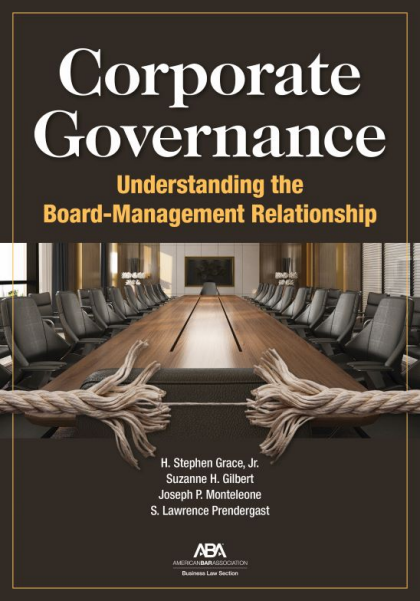
The “G” in ESG stands for “governance.” ESG is of course of one of the most au courant topics in the corporate and securities world, and the inclusion of governance as one of the three ESG pillars inferentially suggests that governance is a new – or at least newly relevant – topic. The reality is, however, that governance is a perennial topic. Its relevance has never diminished, and it remains as important as ever. However, principles of corporate governance do evolve with changing times. It is this evolution of corporate governance that is at the heart of a new book on the topic.

The book, which is entitled “Corporate Governance: Understanding the Board-Management Relationship,” and was written by H. Stephen Grace, Jr., Ph.D, Founder and President of H.S. Grace & Company, Inc.; Suzanne Gilbert, Member Board of Advisors of Grace & Co. Consultancy, Inc.; Joseph P. Monteleone, Esq, Principal Catamount Services, LLC; and S. Lawrence Prendergast, Chairman of the Board of Trustees, Turrell Fund, explores the values-based origin of governance principles; examines the recent progression of governance concepts and considers several recent circumstances that explain the changing concepts; and reviews some of the practical implications of these changing concepts and principles. The book, more information about which can be found here, is a useful and readable summary of current understandings and best practices in corporate governance.

Continue Reading Book Review: Corporate Governance: Understanding the Board-Management Relationship

In recent years, one of the curses of the corporate and securities litigation world has been the ubiquitous filing of merger objection lawsuits in connection with proposed M&A transactions. When a deal is announced, plaintiffs’ lawyers almost always file one or more of these suits in which they seek additional proxy disclosures. After the defendant company agrees to make additional disclosures, the plaintiffs’ lawyers dismiss the suits in exchange for the payment of a so-called “mootness fee.” It is a process that the well-respected jurist Richard Posner famously described as “no better than a racket.”

Now, in a recent decision written by Judge Frank Easterbrook, the Seventh Circuit has identified additional tools and ammunition that companies and other objectors can use to try to fight these kinds of lawsuits —  which, the appellate court specially recognized, have no purpose other than to transfer money from companies to plaintiffs’ lawyers.

Continue Reading Will the Seventh Circuit’s Recent Opinion Deter Merger Objection Lawsuits?

Policyholders are often surprised when their professional liability insurers contend they (that is, the insurers) have the right, after a determination of non-coverage, to seek recoupment of amounts paid under the policy. These disputes can be controversial enough even when the policy expressly provides the insurer with the right to seek recoupment; the controversy is greater when the policy does not expressly provide for recoupment but the insurer nonetheless seeks reimbursement in reliance on its reservation of its rights to seek recoupment.

A recent decision by the Sixth Circuit, applying Michigan law, explored these issues and ultimately affirmed the district court’s ruling that the insurer was entitled to recoup amounts paid in defense after the underlying complaint was amended to remove the only covered claims, even though the policy contained no express recoupment provision. The appellate court’s decision raises several interesting issues, as discussed below. A copy of the Sixth Circuit’s April 8, 2024, opinion can be found here. (Hat tip to Geoffrey Fehling of the Hunton Andrews Kurth law firm whose LinkedIn post linked to the appellate opinion, here).

Continue Reading 6th Circ. Affirms Insurer’s Recoupment Right Even Without Express Policy Grant

The IPO market has been in the doldrums since 2021, but there are promising signs that IPO activity could be on the rebound in 2024. Given the potential for the return of significant IPO activity, it is worth noting that IPO transactions entail certain risks, including in particular for the IPO companies’ private equity backers, as discussed in the following guest post written by Michelle Grimaldi, Assistant Vice President, Claims, Fair American Insurance and Reinsurance Company; Elan Kandel, Member, Bailey Cavalieri LLC; and James Talbert, Associate, Bailey Cavalieri LLC. I would like to thank the authors for allowing me to publish their article as a guest post on this site. I welcome guest post submissions from responsible authors on topics of interest to this blog’s readers. Please contact me directly if you would like to submit a guest post. Here is the authors’ article.

***********************

Continue Reading Guest Post: Looking Ahead: Risks Attendant to a Potential Rebound in the IPO Market for Private Equity
Lisbon

The D&O Diary continued its European sojourn with a visit last week to the sun-drenched and, even though it was still just April, summerlike, country of Portugal. I have to say that writing this blog post about our visit to Portugal was as much fun as I have ever had in writing for this site. Portugal, my friends, is a wonderful place, as I believe the pictures below will show.

Continue Reading Portugal

The COVID-19 pandemic was a disruptive event with the consequences continuing to reverberate through the economy and the business environment, in ways that not only affect companies’ operations and financial performance, but, for at least some companies, in ways that lead to securities class action litigation. So even though the initial COVID-19 outbreak in the U.S. was over four years ago, businesses continue to experience operational consequences from the pandemic, in some cases resulting in securities suits. The latest example is the lawsuit filed late last week against medical testing and diagnostic company QuidelOrtho Corporation, whose testing services revenue declined as the coronavirus transition to endemic status. A copy of the April 12, 2024, complaint against QuidelOrtho can be found here.

Continue Reading Diagnostic Testing Company Hit With COVID-Related Securities Suit

As readers of this blog well know, life sciences companies are frequent targets of securities class action lawsuits. Interestingly, at least according to the latest annual report from the Sidley law firm, in recent years the number of lawsuits filed against life sciences companies has declined, although the lawsuit frequency against life sciences companies still remains elevated by comparison to the frequency of litigation against the universe of public companies. Perhaps even more importantly, motions to dismiss in securities lawsuits filed against life sciences companies are granted more than half of the time. A copy of the law firm’s April 2024 memo, entitled “Securities Class Actions in the Life Sciences Sector: 2023 Annual Survey,” can be found here. A two-page summary of the report can be found here.

Continue Reading A Detailed Look at the 2023 Securities Litigation Against Life Sciences Companies