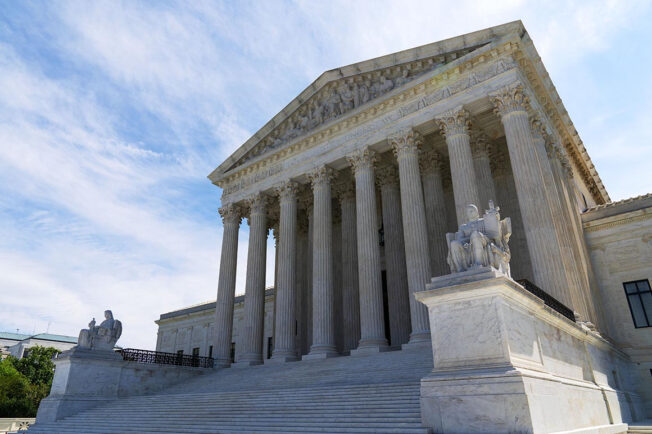
The U.S. Supreme Court only rarely agrees to take up consideration of cases involving securities law issues, so it was a noteworthy event when the Court agreed late last week to take up a case involving the SEC’s enforcement powers. As discussed below, the case involves questions of what the SEC has to prove in order to secure disgorgement from alleged wrongdoers. The Court’s ruling in the case, which is captioned Sripetch v. SEC, will address a split in the Circuit Courts on the question of whether the SEC must prove that investors were harmed by the wrongdoers’ acts in order to obtain disgorgement.Continue Reading Supreme Court Agrees to Consider SEC’s Disgorgement Remedy Rights

Sarah Abrams

Last fall the U.S. Supreme Court dismissed, as improvidently granted, the writ of certiorari in two pending securities lawsuits, including in the Meta Platforms/Facebook case (as discussed here). The Court’s dismissal of the writ of certiorari in the Facebook case had obvious implications for the immediate litigants in the case, as it left the prior circuit court ruling standing. But the dismissal also has important implications for litigants in other cases involving the same issues as were raised in the Facebook case.

In the following guest post, Sarah Abrams, Head of Claims Baleen Specialty, a division of Bowhead Specialty, considers the implication for those other litigants in those other cases in light of the Supreme Court’s dismissal of the writ of certiorari in the Facebook case. I would like to thank Sarah for allowing me to publish her article as a guest post on this site. I welcome guest post submissions from responsible authors in topics of interest to this site’s readers. Please contact me directly if you would like to submit a guest post. Here is Sarah’s article.Continue Reading Guest Post: Location, Location, Location

At the outset of the current U.S. Supreme Court term, corporate and securities law observers and commentators were excited that the Court had agreed to take up two securities law cases that had significant potential to provide insights about securities lawsuit pleading standards and processes. However, as noted here, in November, the court dismissed

The current Supreme Court term promised to be an interesting one from a securities law standpoint, as the Court had agreed to take up two cases dealing with key securities class action litigation issues. One of those cases is the securities case involving the Facebook/Cambridge Analytica’s user data scandal. The Facebook case would have required the Court to address an important and recurring disclosure related issue. However, on November 22, 2024, the Court issued a single-line order stating that “the writ of certiorari is dismissed as improvidently granted,” meaning that the Supreme Court’s consideration of the Facebook case will now not go forward, and the Ninth Circuit’s ruling in the case, in which the appellate court reversed in part the district court’s dismissal of the case, will now stand. A copy of the Supreme Court’s November 22, 2024, order can be found here.Continue Reading U.S. Supreme Court Dismisses Facebook Case, Saying Writ Improvidently Granted

Just days after the U.S. Supreme Court agreed to take up the Facebook/Cambridge Analytica securities case concerning risk factor disclosures (as discussed here), the Court has now agreed to take up yet another securities case, this time in a case involving Nvidia and involving the standards for pleading scienter and falsity under the PSLRA. The NVIDIA case involves alleged fraud in connection with the company’s disclosures concerning its sales of graphics processing units (GPU) to cryptocurrency companies as a component of its overall GPU sales. The specific questions the case presents to the Supreme Court concern what and how a plaintiff must plead when pleading scienter and falsity. Because the case involves the PSLRA’s “exacting pleading requirements,” the case potentially could prove to be very significant. A copy of the Court’s June 17, 2024 Order granting the petition for writ of certiorari can be found here.Continue Reading Supreme Court Agrees to Take Up Nvidia Securities Suit On Pleading Standards Issues

The U.S. Supreme Court has agreed to take up a case in which the court will be asked to address the recurring question of whether the failure to make disclosure required by Item 303 of Reg. S-K is an actionable omission under Section 10(b) and Rule 10b-5. The Court apparently agreed to take up the case due to a split between the Circuits on the question of whether or not an Item 303 violation can be actionable. Because allegations based on alleged Item 303 violations are a frequent feature of securities class action complaints, the Court’s ruling in the case could potentially be significant. A copy of the Court’s September 29, 2023, order granting the petitioners’ petition for a writ of certiorari in the cases, Macquarie Infrastructure Corporation v. Moab Partners, L.P., can be found here.Continue Reading Supreme Court to Consider Whether Item 303 Violations are Actionable under Section 10(b)