Tirana

The D&O Diary’s European travels continued earlier this week with a first-time ever visit to Albania, the rugged country on the Adriatic and Ionian coasts of the Balkan Peninsula, tucked between Montenegro and Greece. The country still retains many vestiges of its 20th century communist era, but it is modernizing quickly, and it remains a topographically diverse, naturally beautiful country.

Albania is geographically small, only about the size of the U.S. state of Maryland. The country has a population of about 2.4 million people, with the largest number located in its capital, Tirana. For most of the 20th century, Albania was one of Europe’s poorest countries, owing to its economic and political isolation, and infrastructure limitations. Since the 1991 collapse of the country’s communist regime, and particularly in the most recent years, the country has made great strides, particularly in infrastructure development and education. Many of the vestiges from the country’s earlier struggles remain, however.

The first stop on my Albania tour was to the country’s capital city of Tirana, located in the country’s center and surrounded by mountains. Tirana is a big, busy city, now bristling with a number of new, taller buildings in the city center. Some areas of the city –particularly in outlying areas — still retain a ramshackle feel from the the country’s 20th century isolation, while the center city projects an air of aspirational dynamism that is palpable.
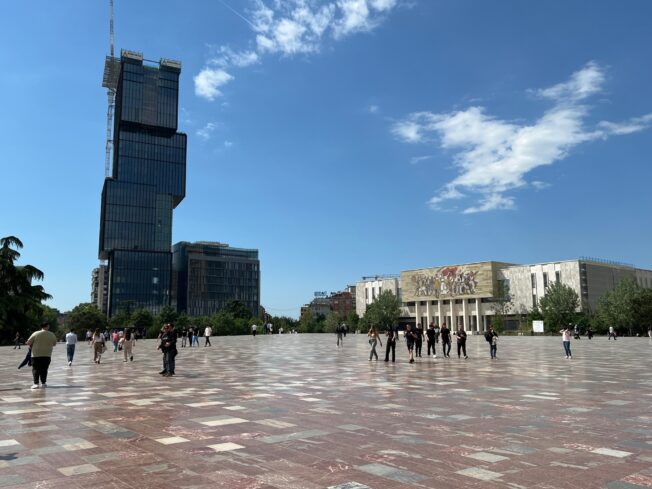
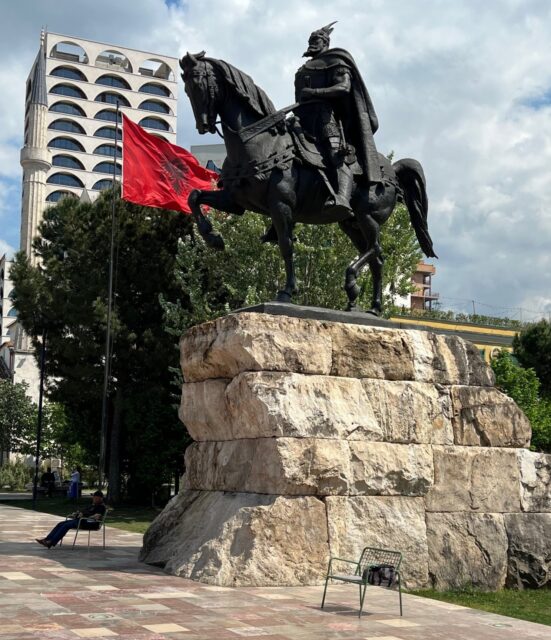
The main plaza in the center of Tirana is Skanderbeg Square. The square covers roughly an acre. It is surrounded by a number of locally important historical and cultural sites, including the Palace of Culture, the National Historical Museum, and the Et’hem Bey Mosque. It is a big, wide-open, wind-swept plaza, but I have to say I preferred the city’s many green spaces to the granite covered square.
This is the statue of Skanderbeg, the 15th century figure, famous for fighting the Ottomans, and for whom the sqaure is named.
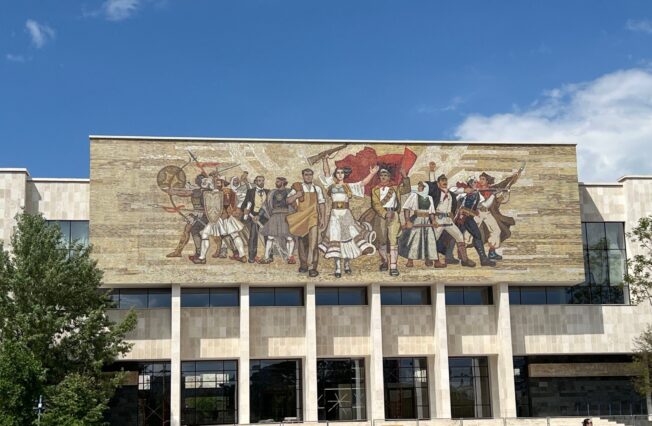
This socialist realist mosaic, entitled The Albanians, is displayed above the entrance to the National History Museum. It depicts a number of figures drawn from Albania’s history and national mythology.
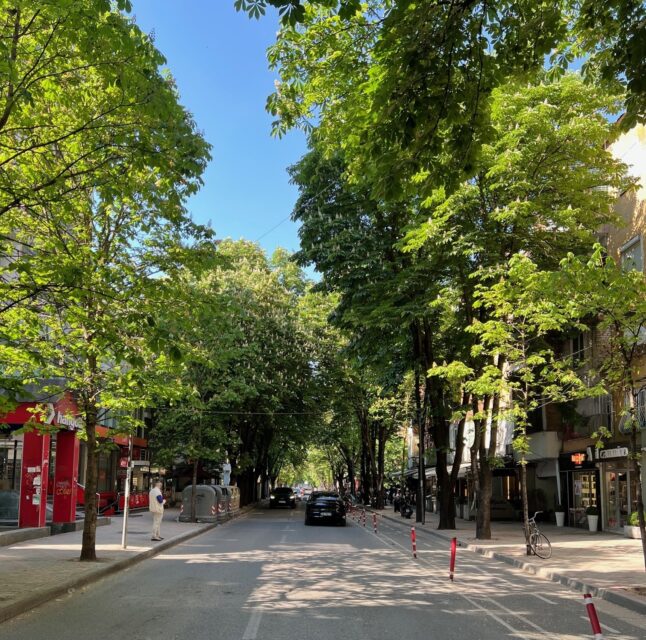
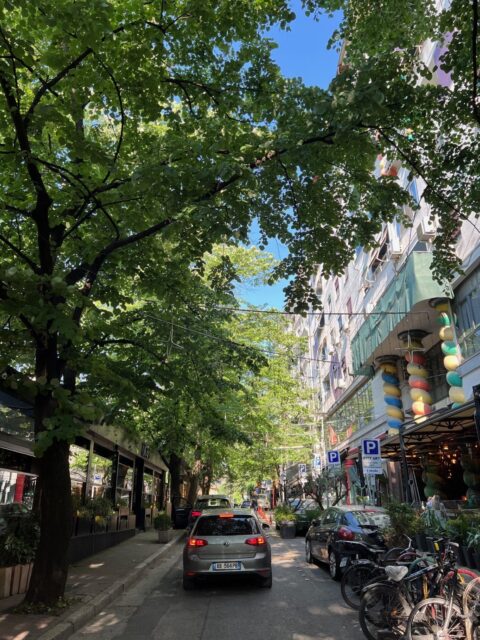
Tirana is a very walkable city, and as I strolled around, I was struck by how green the city is. Many of its neighborhood streets are tree-lined. This picture shows a street in the Blloku district, an area that was home to many senior officials during the communist era and that was closed to others.
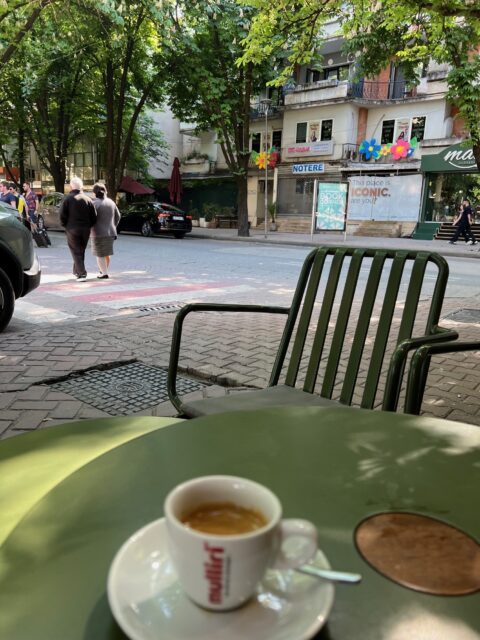
The Blloku district is now has a very lively street life and is home to a host of cafés, bars, and restaurants. It is a particularly nice area in which to walk around.
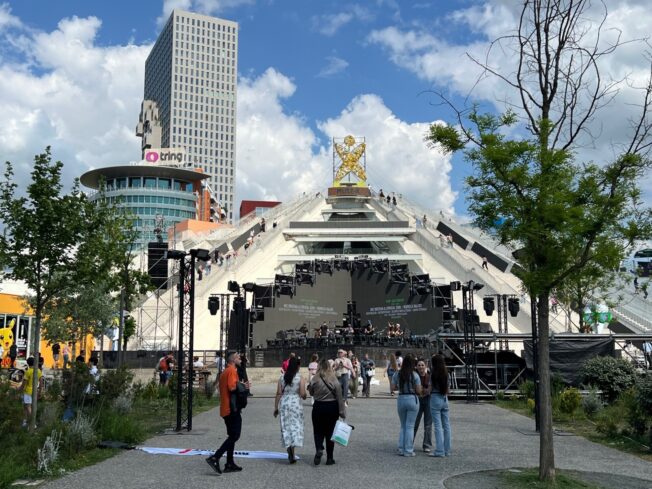
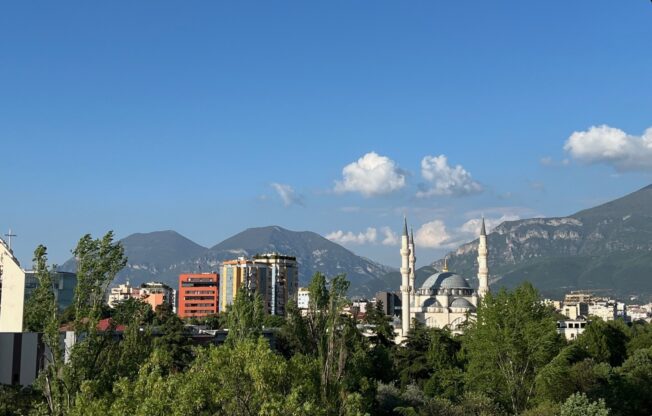
This picture shows the Pyramid of Tirana, which was just a block from my hotel. The Pyramid was originally built as a museum of the history of communism in Albania and as a memorial to the country’s communist dictator, Enver Hoxha. The building has served a variety of functions since the fall of communism, and most recently has been repurposed as a center for the visual and performing arts. I was fortunate that on the day of my arrival in Tirana there was a very lively music festival going on. It was great fun, but, man, was it loud. The views from the top of the Pyramid are great — the picture at the top of this post was taken from the Pyramid.
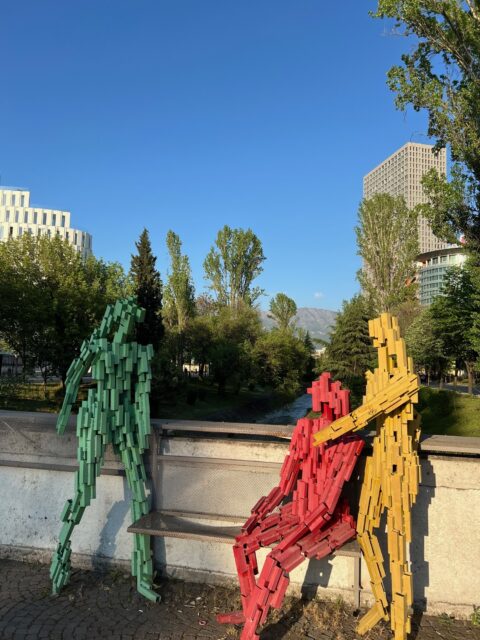
The Pyramid is located just south of the Lanë River. On one of the river bridges, there are a number of these sculptures of human figures, giving the river crossing a colorful, stylized feeling. I liked them a lot, and I noticed that many passersby stopped to take pictures of the sculptures.
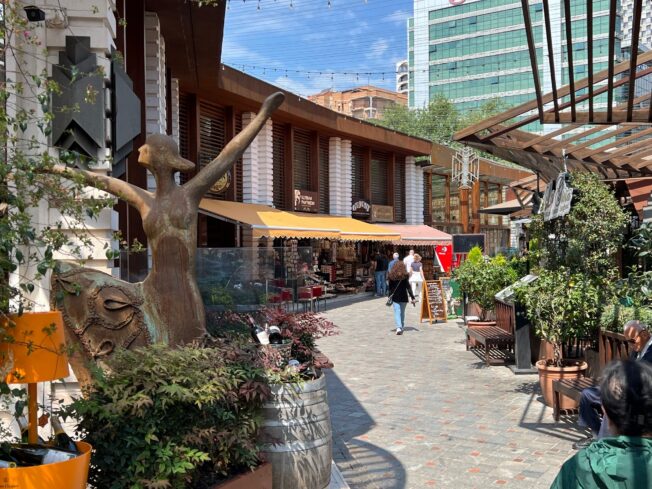
On the north side of the river, just to the east of Skanderbeg Square, are the remnants of the Castle of Tirana, also known as the Fortress of Justinian. Not much remains of the original structure, but what what is left has been repurposed into a high-end area of restaurants and shops. It has a built-for-tourists air but it is still a nice place to have a morning cup of coffee.
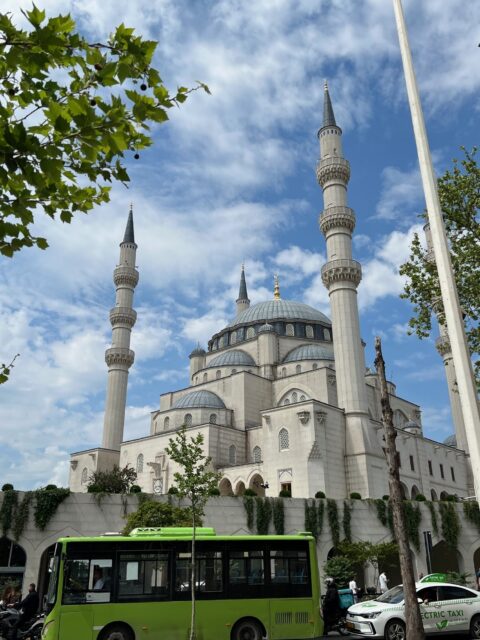
Near the Castle, on the north side of the river, is the Great Mosque of Tirana. With a capacity for 10,000 worshipers, it is the largest mosque in the Balkans. During the era when the country was under Ottoman control, many Albanians converted to Islam. Today a majority of Albanians are Muslim. There was a smaller, neighborhood mosque near my hotel. Each morning while I was in Tirana, I was awoken by the sounds of the Fajr, the morning call to prayer. Notwithstanding the orominence of these Islamic features, Albania is officially a secular state and neutral on matters of religion and belief.
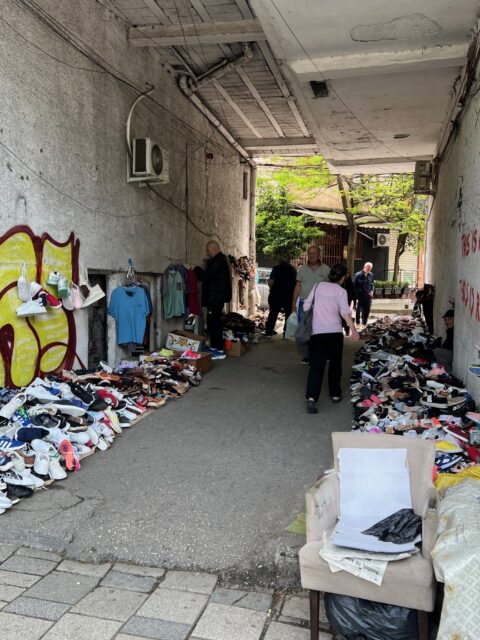
Hey, do you need shoes? I know a guy…

My hotel was on this quiet, tree-lined street near the Pyramid. A number of countries have their embassies on this street, including Austria and the Islamic Republic of Iran. There was a guard post at the entrance to the Iranian embassy. I probably passed by the guard post a half a dozen times while I was in Tirana. Each time, the guard inside the post was fast asleep.
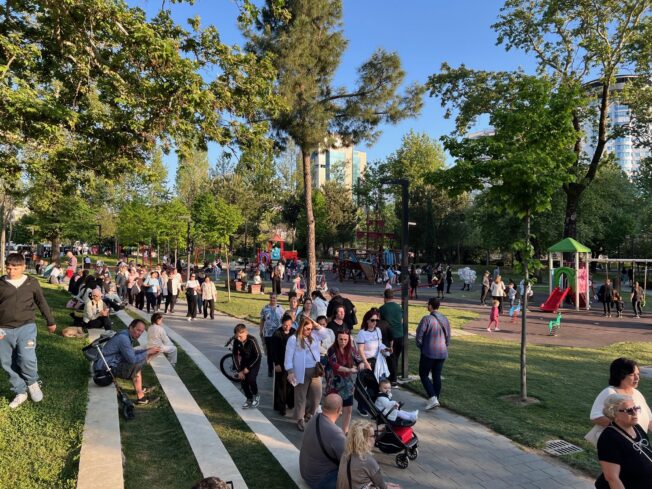
As my pictures reflect, the weather was great while I was in Tirana. The warm weather brought the people out for a stroll in the evening. This picture was taken in Rinia Park, which is across the river from the Pyramid. (I much preferred Rinia Park to Skanderbeg Square.) The scene felt to me like the evening Paseo which I have experienced and enjoyed in Spain. I have to say I didn’t expect to see or experience anything like this in Tirana. The was such a pleasant surprise.

After my brief visit to Tirana, I was off to explore other areas of Albania. I went next to Vlorë (pronounced VLOR-uh), two hours south by car from Tirana and part of the coastal area of the country known as the “Albanian Riviera.” Vlorë, which has a population of just under 100,000, is at the northern end of Albania’s Ionian coast. The city was briefly the capital of Albania at the time the country first became independent in 1912.
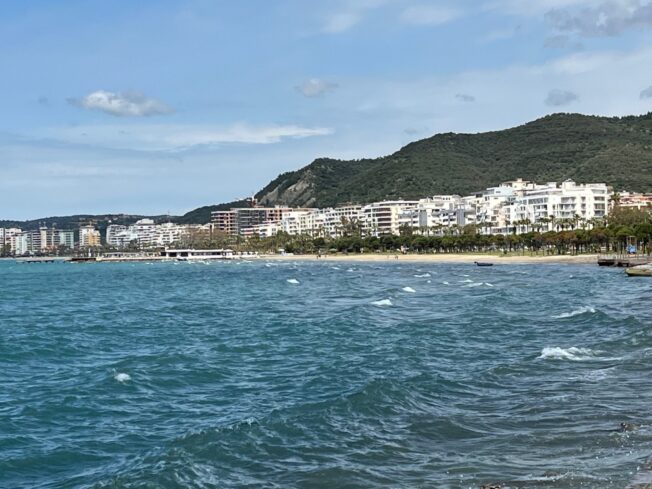
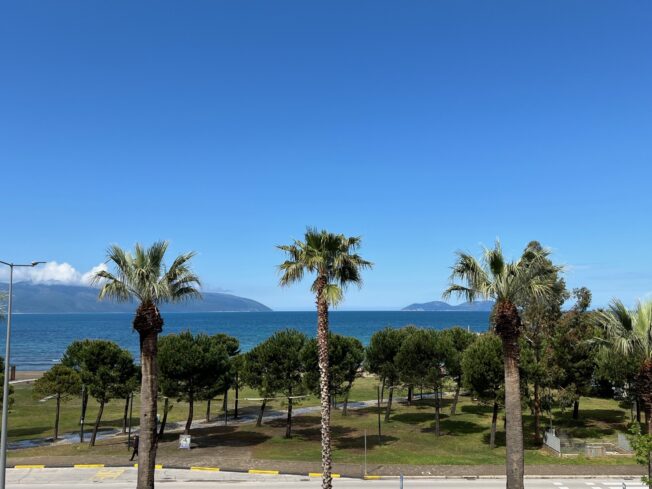
The waterfront in Vlorë is lined with hotels, apartments, and condominium buildings. Many of the buildings, particularly away from the waterfront, are older construction; they were never particularly well built and many are now crumbling, giving parts of the city a down-market feel. On the other hand, most of the recent construction (of which there is quite a bit) is very high-end. The city is definitely aiming to go up market. Some of the new developments are even a little bit over the top. Large parts of the older waterfront area are now being developed into a massive marina and hotel complex, supposedly being financed by the Saudi Public Investment Fund. The locals are also abuzz with the news that Donald Trump’s son-in-law Jared Kushner has made a massive investment on an island off the coast of Vlorë with plans to develop it into a luxury resort.

This is the view from my hotel window. The island to the right is Sazan Island, the island that Jared Kushner is planning to develop. You may notice the absence of people in this picture. It had never occured to me that late April would be too early in the season for a visit to the Albanian coast. I have to say that the place turned out to be … not lively. You may also wonder how high rollers will be attracted to a destination as remote as Vlorë. You shold know that a new international aiport is scheduled to open in Vlorë later this year. No doubt in Jared Kusnhner’s mind bringing squadrons of visitors to his planned island resort.
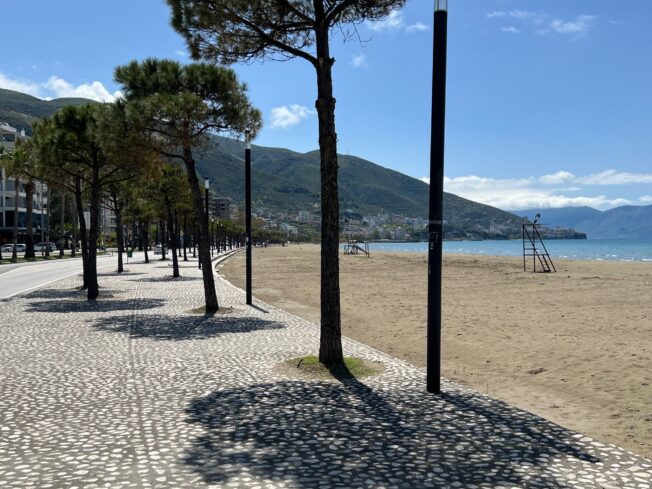
Along the waterfront in Vlore is a very pleasant walkway, the Lungomare Promenade. The walkway unifies the beachfront and provides a plesant prospect of the sea. I suspect that in the season the area is bustling.

Vlorë is great and by all rights I should have enjoyed a great visit there. Unfortunately something unexpected happened on the day of my first visit. A dog bit me. I had seen the group of about five or six dogs lounging on the beach on the outbound leg of my first seashore walk upon arrival. They paid no attention to me and I paid no attention to them. On my return, I noticed that the dogs were up and moving around, but again I paid no attention. Before I realized what was happening, one of the dogs had wheeled around behind me, and bit me on the leg. This was not a friendly nip. This was a forceful, vicious bite that was intended to do damage. My first instinct was to retaliate, but when I shouted and wheeled around to face the dog that attacked me, the other dogs suddenly perked up their ears and took three or four steps toward me. I realized that if I took even one more step, I would be dealing with six dogs, not just one dog. I backed away and headed to my hotel room and cleaned out my wound. (I always keep a stash in my backpack of those alcohol wipes that the airlines started to give out to passengers during the pandemic.) Enough time has passed that I think I can be sure that the bite wound won’t get infected, but the incident certainly affected my perception of Vlorë. Travel can be so much fun, but it can all go bad in a big hurry, too.
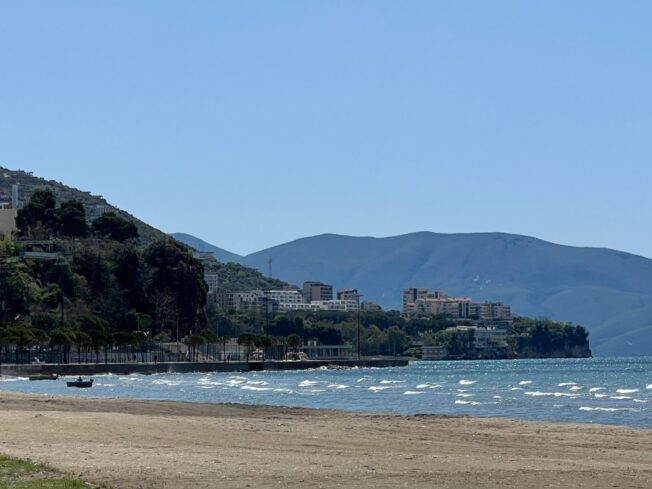
Because I don’t want to end my description of Vlorë on such a down note, I have included another picture here. It is a plesant place to visit, though they really do need to do something about the dogs.

I know from my convesations with other Americans as I was planning to on this trip that there are three things I need to address about Albania as part of this travel post.

First, is Albania safe? Pretty much every single American to whom I mentioned that I was going to Albania asked me this questoin. (They were not asking about the dog problem in Vlorë; they were asking about crime.) I would say that Albania is as safe as any other European country. I certainly saw nothing (other than the stupid dogs) that gave me even the slightest concern. I think Albania’s vague reputation for crime reflects the fact that its prior communist regime was a corrupt mafia state. I have to say, at no point during my visit did I have even the slightest concern about my safety or security (at least as pertains to other humans).

Second, what about the currency? It is true that Albania is mostly a cash only country. Perhaps this is a vestige of the day when it was a corrupt mafia state, as a result of which there is little trust in the financial system, so cash is king. I also was told that the bias in favor of cash is reflection of tax aversion. The local currency in Albania is the lek. The current exchange rate is roughly 80 leke to the U.S. dollar. However, many shops and restaurants will take Euros. On each occasion when it was time for me to pay, I found myself wresting with a pocketfull of bills and coins. My main objective was to make sure I spent all of my leke, as they certainly were not going to be useful anywhere else. It has been a very long time since I have had to mess around with cash while traveling, and I have to say it is a huge pain.

Third, what about the language? It may come as no surprise to you that I do not know a single word of the Albanian language. As it turned out, my ignorance of the Albanian language was never a problem. Pretty much every one I interacted with spoke at least a little bit of English. In fact, most people started out addressing me in English. The young people in particular seem very comfortable interacting in English.

Overall, I had a great visit to Albania. I know I should not let the stupid dog bite color my perception, but I would be lying if I tried to pretend that it did not. To the extent I can put the dog bite out of my mind, I am able to say that otherwise I enjoyed my Albanian visit, and subject only to a warning about the dogs, I would recommend Albania as an interesting, different kind of place to visit.