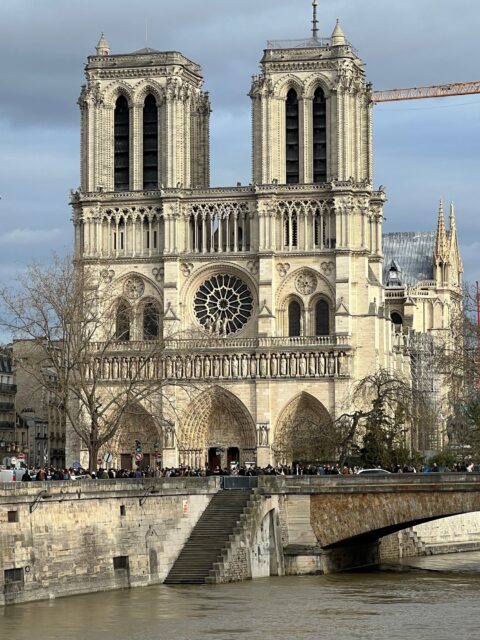
Notre-Dame de Paris

The D&O Diary is on assignment in Europe this week, with a first stop in Dublin for client meetings, followed by a long weekend visit to Paris. February is not the best time to visit Europe, as it can be cold and dark, and on this visit both cities were kind of damp, as well. But notwithstanding the generally gloomy and occasionallly wet weather, it was a great visit overall.

Dublin is such a great place to visit, even in the winter gloom. It is so pleasantly walkable and full of life. During our short Dublin, we did enjoy occasional breaks of sunshine, which help a little bit to lift the winter gloom.
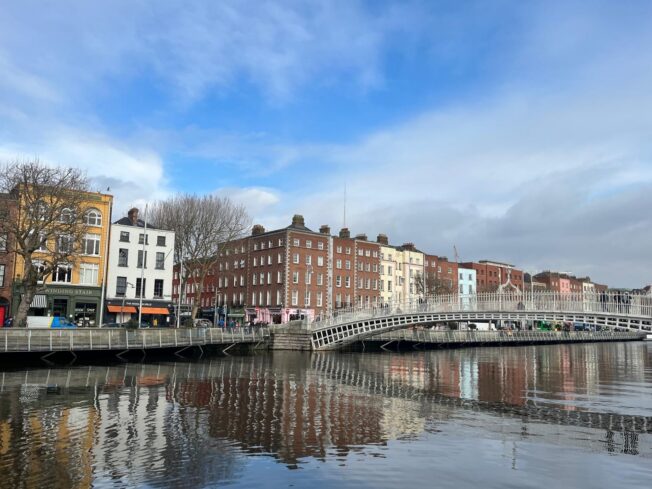
Dublin, Ireland’s capital and largest city, is located on the River Liffey, which is crossed by multiple traffic and pedestrian bridges. Here is a view of the river and of the famous Ha’Penny Bridge. At the far left side of the picture, you can just see the green facade of The Winding Stair, a small, interesting bookstore. On the second floor above the bookstore is a restaurant of the same name.
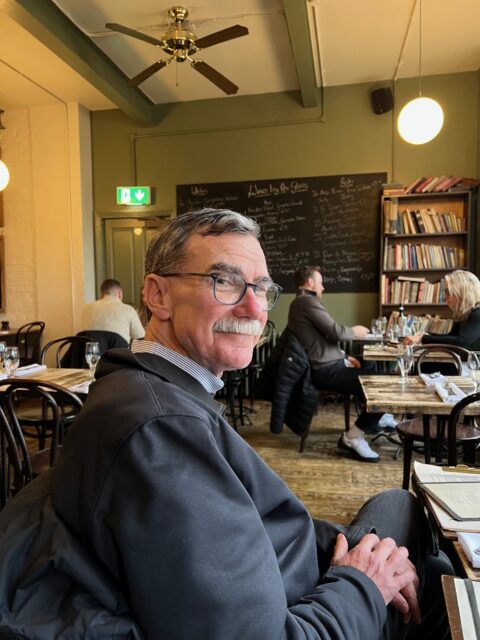
At lunch in The Winding Stair restaurant. I highly recommend the restaurant, particularly for a jet lag day lunch. The dining room is quiet and pleasant and has great views of the river and of the Ha’Penny Bridge. The food is tasty.
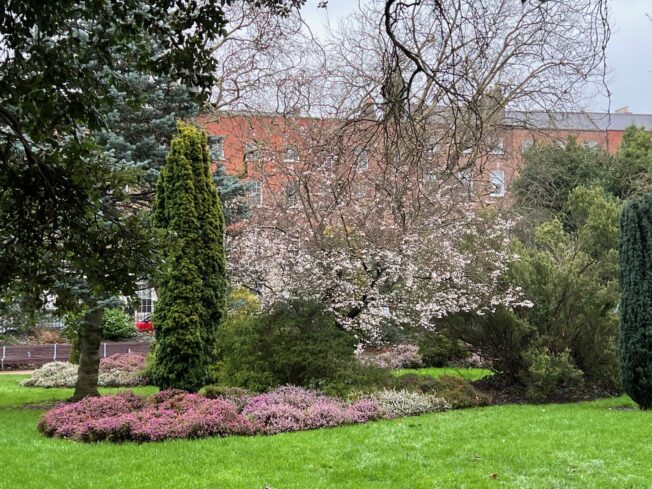
Though Dublin was definitely under winter’s gloom during our visit, there were some signs that spring may not be that far away. These trees and shrubs in Marrion Square were already showing promise of more pleasant days to come. You can’t really tell from the photo, but when I took this picture it was pouring rain.
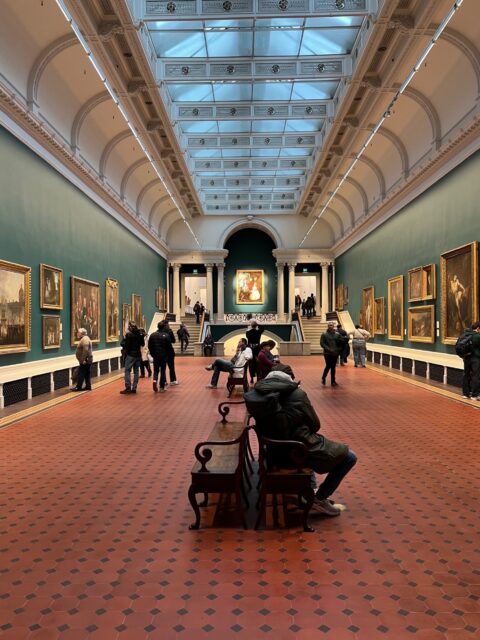
Directly accross from Marrion Square is the main entrance of the National Gallery of Ireland, which has an interesting collection of European Art (including works by Rembrandt, Goya, and Vermeer) and an impressive collection of Irish Art. The museum has a welcoming, agreeable atmosphere, and it is a very congenial place to spend a rainy Dublin afternoon.
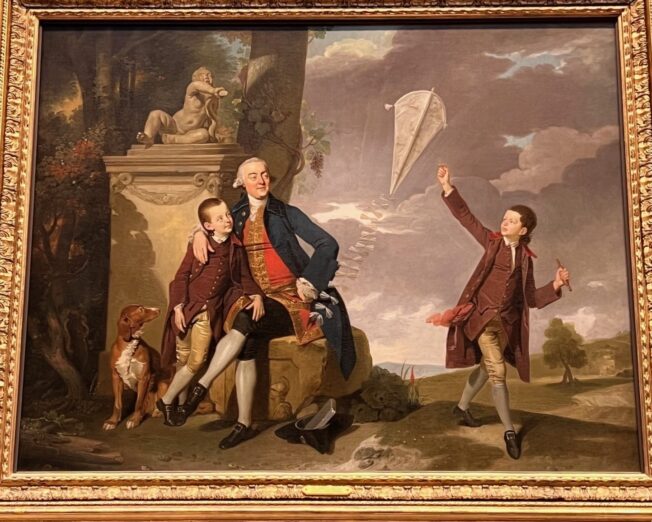
One thing we particuarly enjoyed about the museum was the descriptions of the art works in their accompanying wall labels. This 1764 painting by Johan Zoffany of George Fitzgerald and his sons is described as follows: “Wearing a captain’s uniform, from his time in the Austrian army, George Fitzgerald of Turlough Park, Co. Mayo sits with his younger son Charles. The older brother George Robert is shown flying a kite. Zoffany creates an illusion of carefree contentment but the reality was quite different. Fitzgerald was separated from his wife Lady Mary Hervey. The two boys lived in London with their mother while their father led a dissolute life. George Robert became a gambler and was eventually hanged for murder.”

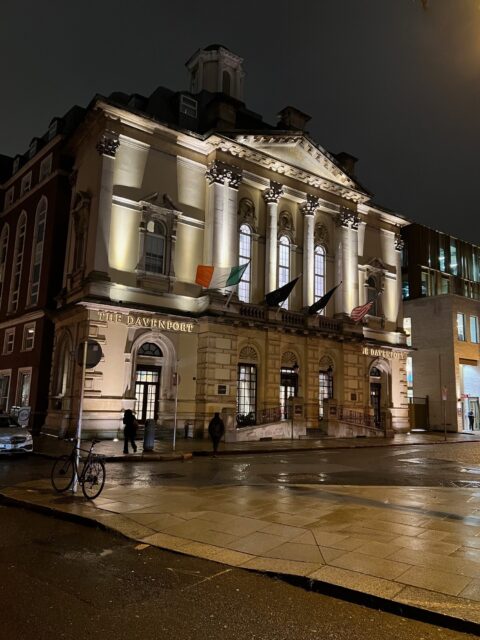
For anyone planning a trip to Dublin, I have a hotel reserviation. On this trip, we stayed at the Davenport Hotel, which is just near Marrion Square and the Art Museum, and just a short walk away from Trinity College and the Temple Bar district. I have now stayed at this hotel several times and I have enjoyed it each time. The rooms, which are quiet and clean, are pleasantly old-fashioned. Two thumbs up.

Our visit to Dublin was short, and we were soon off for a weekend visit to Paris. It is surprisingly inexpensive and easy to travel from Dublin to Paris — the air fare was just a little more than 100 euros. In a scene change so dramatic it almost gave us whiplash, we quickly found ourselves in Paris and on an RER train from Charles de Gaulle airport on our way into the center city.
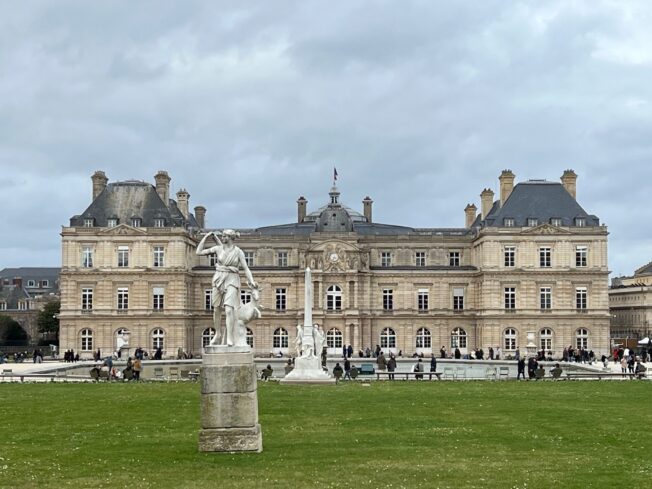
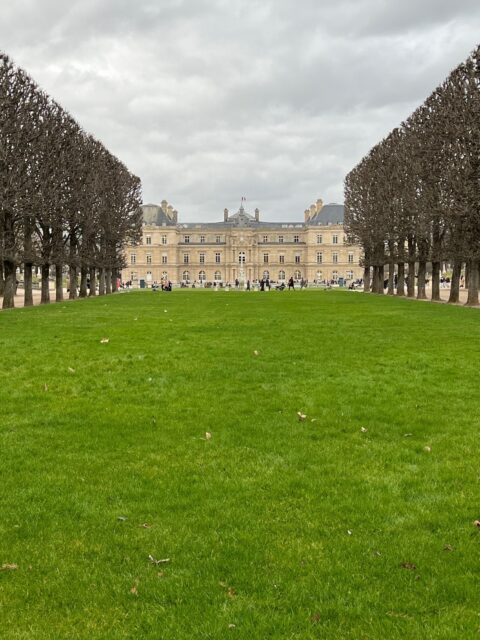
I have been to Paris many times before, but it never gets old. Upon arrival in Paris, the first thing I have to do is to walk through the Jardin du Luxembourg, which is about as pleasant a place as there is in the entire universe. The scene and the feel of the gardens changes with the seasons, but the general ambiance is unchanging. When I am there, I am fully in Paris and I become aligned with the essential spirit of the city.
Another view of the Palais du Luxembourg. In his memoir of his time in Paris, A Moveable Feast, Ernest Hemingway wrote “There is never any ending to Paris and the memory of each person who has lived it differs from that of any other.” Hemingway’s words confirm a view I have long held, which is that everyone who has visited the city believes, like me, that nestled within the city’s timeless monuments and beautiful streets is their own personal Paris. I sometime think that Paris is like an experienced courtesan who manages to convince her many lovers that each of them alone is the only one that has enjoyed her secret pleasures.

After our mandatory arrival walk through the Jardin du Luxembourg, our next stop was a visit to Notre Dame. I saw the renovated and re-opened church on my prior Paris visit, but my wife had not seen it, so we had to stop and see it.
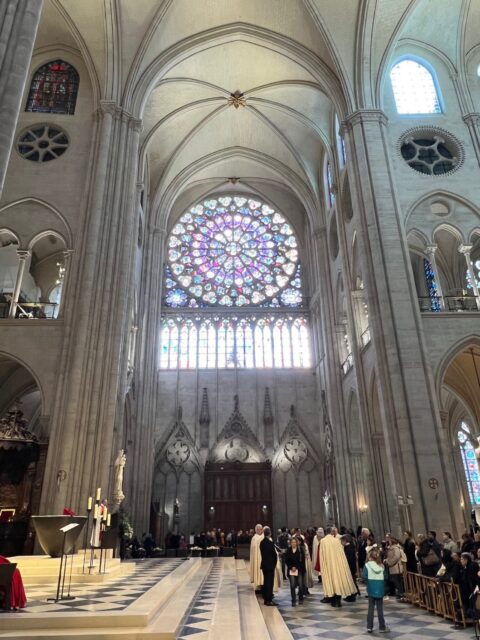
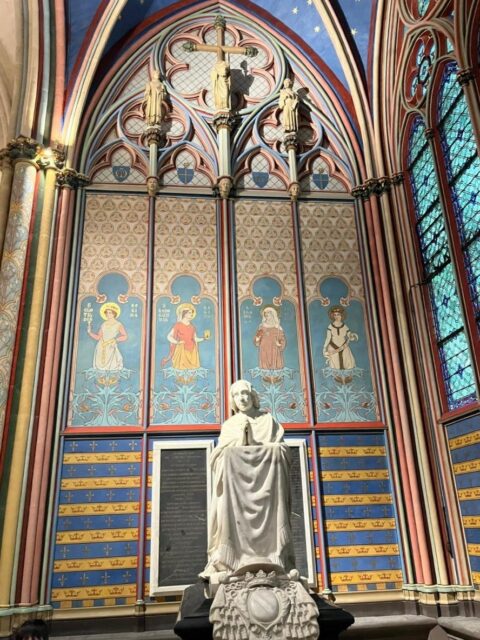
Even though I had already seen it once before, I was once again struck upon entering the restored nave how bright and clean it feels. The brilliant interior is breathtakingly beautiful, the limestone surfaces almost glowing in the flood of natural daylight. The restored stained glass also adds a richer, more vivid light.
The bright color of the church’s interior comes not only from the stained glass windows but also from the repainted surfaces, which postively glow with a warm palate of rich, bright colors.

On Saturday morning, we had a major project, which was to visit the Musée d’Orsay, for a very specific objective. Over the winter, I had read Sue Prideaux’s excellent one-volume biography of Paul Gauguin. entitled Wild Thing. I had never really clicked with Gauguin’s art before, but reading the biography left me wanting to see his work again, particularly the paintings from his Tahitian travels. The Musée d’Orsay has an excellent collection of his paintings and sculptures, particularly from Gauguin’s time in Tahiti. It was great to have a chance to see and consider the paintings after having read the book. The paintings’ vibrant colors had always been apparent; closer consideration revealed the depth and even the mystery of the work. (I highly recommend the book even if you will not have an immediate opportunity to study Gauguin’s art in person.)
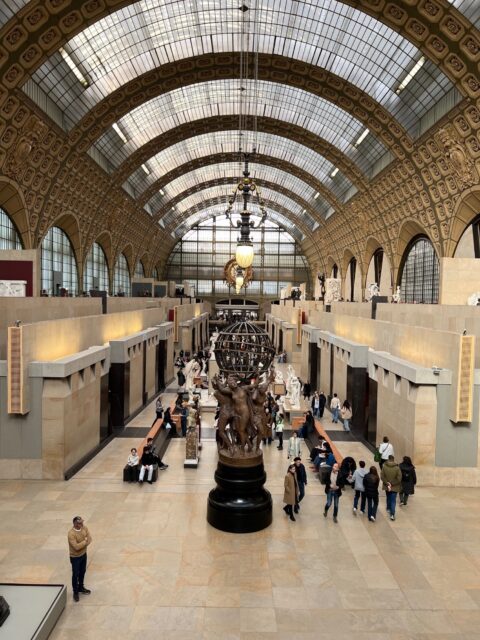
The central nave of the museum (formerly the train station’s main platform area) is a huge, soaring, light-filled hall, with long rows of marble statutues and bronze sculptures, and replete with decorative ironwork, gilded accents, and restored architectural flourishes.

The museum’s Fifth (top) floor is full of some of the most famous artwork from the Impressionist and Post-Impressionist era. The galleries with the work of Van Gogh, Monet, and Cezanne were absolutely packed while we were there. The separate galleries with Gaugain’s work, located at the end of a long series of rooms with Impressionist art, were relatively uncrowded, allowing plenty of opportunity for study and contemplation.
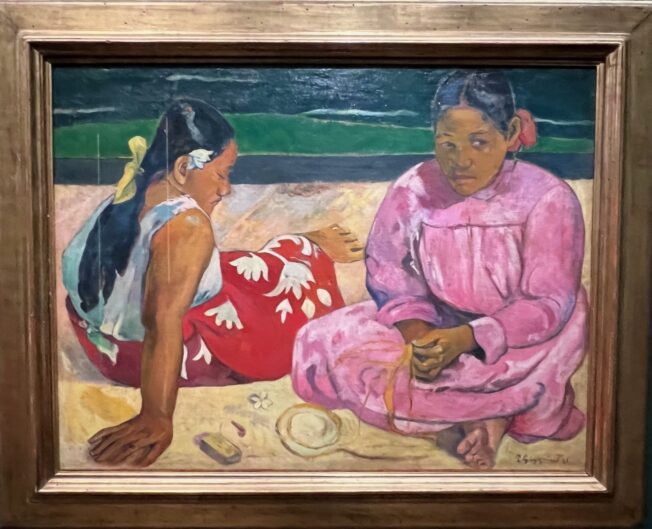
This painting, entitled Femmes de Tahiti (1891), is representative of Gauguin’s South Pacific art. Colorful, bold, and, to our eyes, exotic, the painting also has an air of serenity, and, perhaps, mystery. Today, there are those who criticise Gauguin for his alleged cultural appropriation and his supposed “colonial gaze,” but even allowing for these concerns, there is no doubt that he had an expansive and innovative artisitic vision. For me, it is enough to appreciate the works’ beauty and depth.

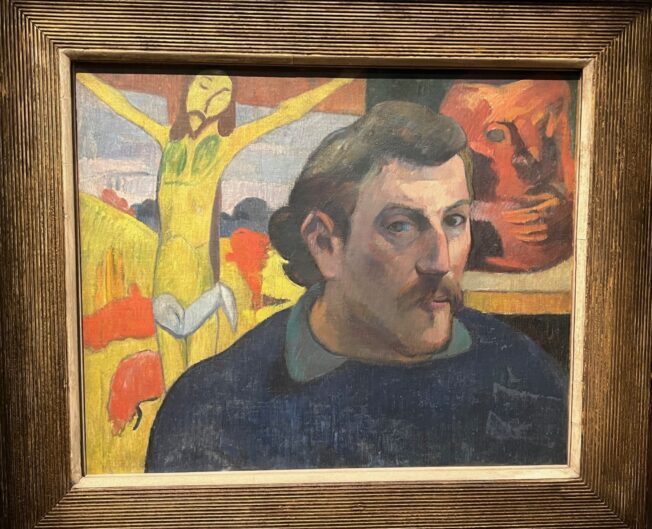
Gauguin painted this self-portrait of himself in front of two of his own prior paintings (including the Yellow Christ) in 1891, just before he left for Tahiti. Gauguin was not always a likeable person but he lived a fascinating life. Anyway, even if you have been to the Musee d’Orsay before, it is worth a return visit just to see and contemplate Gauguin’s work.

On Sunday morning, we had a different project, which required us to visit the Cimetière de Passy, located near the Place de Trocadéro, across the river from the Eiffel Tower. Admittedly, the cemetery is not on many tourist itineraries. Our purpose in visiting was to see the grave of the impressionist painter, Édouard Manet. My desire to see his grave arose from reading yet another book over this past winter, Sebastian Smee’s Paris in Ruins: The Siege, The Commune, and the Birth of Impressionism. The book tells the story of Paris durng the Franco-Prussian war and its immediate aftermath, from the perspective of two of the key painters of the Impressionist era, Manet and Berthe Morisot. The two artists had a deep and enduring relationship, in which each influenced the other artistically. Morisot would go on to marry Manet’s brother, and both the brother and Morisot are buried next to Manet. (I have often thought there is the plotline here for an interesting movie in the two artists’ story.)
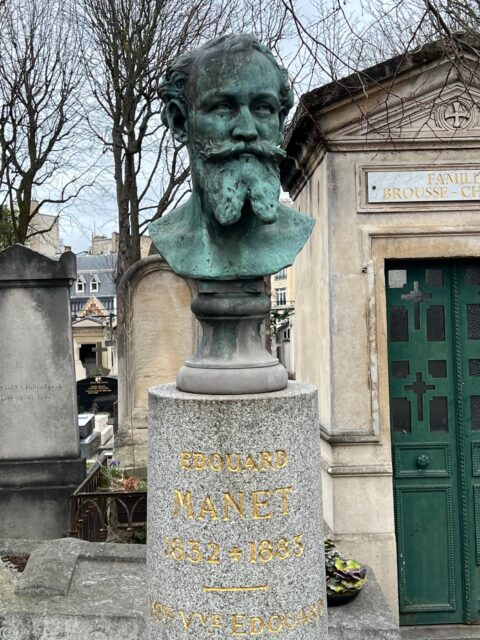
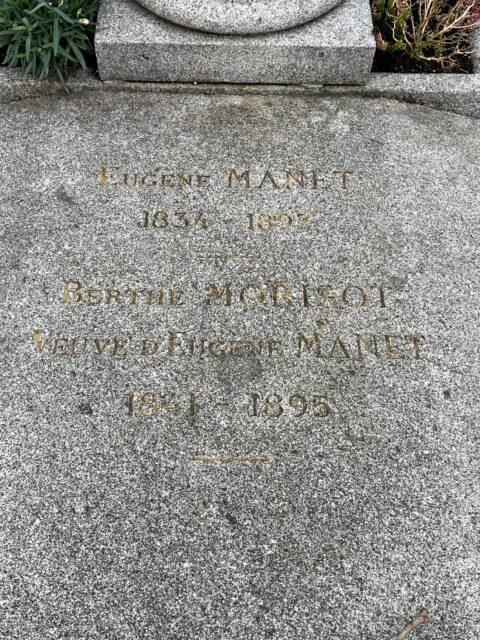
This is the grave marker of Eduoard Manet, in the Cimetière de Passy. I highly recommend the book at Paris in the Franco-Prussian war and about the relationship between Manet and Morisot.
The grave stone of Berthe Morisot and of Manet’s brother, which is next to Manet’s grave marker.
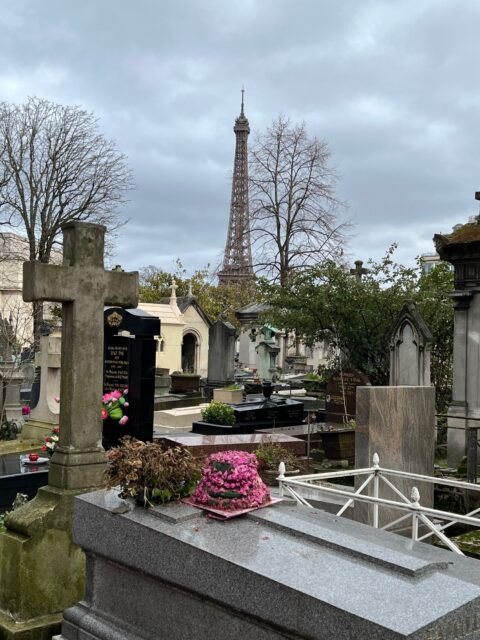
A view of the Eiffel Tower from the Cimetière de Passy.
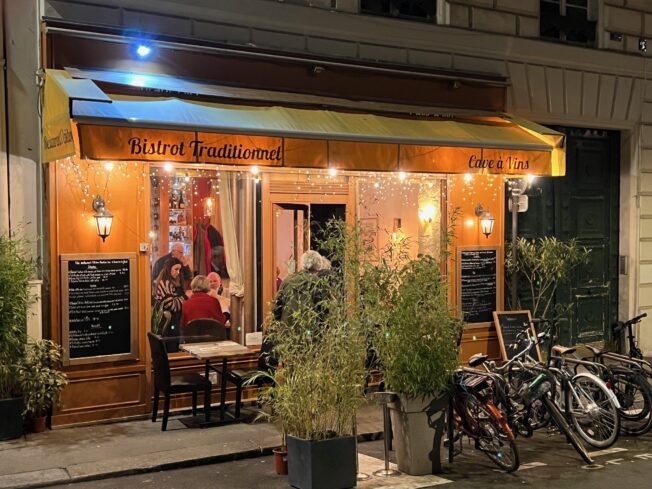
I have a restaurant recommendation for anyone visiting Paris anytime soon. The restaurant is L´Épidon, located on Rue Casimir Delavigne, in what I think of as “our neighborhood” in Paris, the area between the Odéon metro stop and the Jardin du Luxembourg. We have walked past the restaurant many times, but this time we finally decided to try it out. It was excellent. It is the quintessential small (ten tables) French bistro, serving updated, well-prepared and well-presented classics. Honestly, if you want the archtypical French restaurant experience in a pleasant atmosphere without a lot of fuss or bother, this is it.
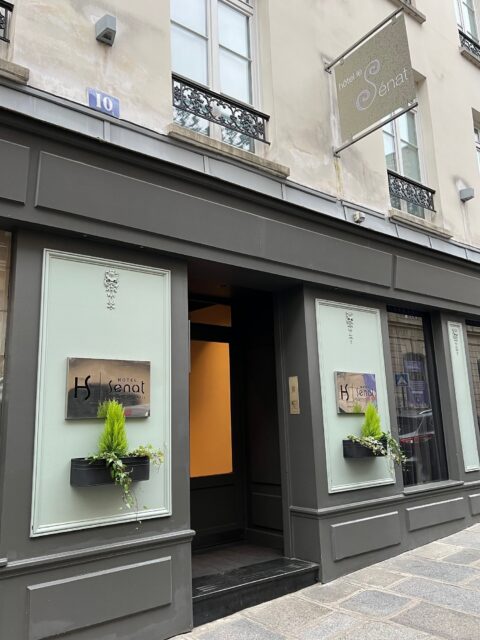
I also have a hotel recommendation as well. It is the Hotel le Senat, located on rue de Vaugirard, a quiet side street just steps away from the entrance to the Jardin du Luxembourg. We have now stayed at the hotel at least four or five times. We particularly like the spacious and comfortable two-room suites on the top floor. The rooms are clean and quiet, and decorated in a vintage, Parisian style. The hotel is also located just a couple of hundred yards from an RER B train station and a five-minute walk from the Odeon metro station.

The only problem with visiting Paris is that eventually you have to leave. We were off on Monday morning on the Eurostar train for London. The thing about leaving Paris is that even as you are just departing, you are already thinking about when you will return.