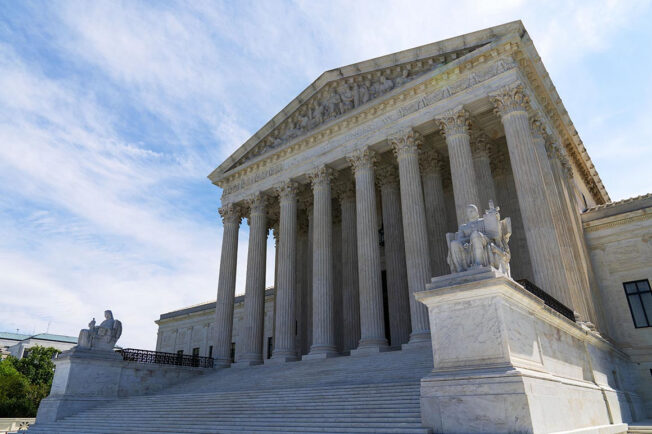
Last Friday, the U.S. Supreme Court issued its much-anticipated ruling in the case challenging the tariffs President Trump imposed in reliance on the International Economic Emergency Powers Act (IEEPA). By a 6-3 majority, the Court ruled in Learning Resources v. Trump that the IEEPA does not authorize the President to impose tariffs. However, even though the Court has now ruled, questions and uncertainty remain. As discussed below, the continuing questions have important implications for companies’ tariff-related D&O risk. The Court’s February 20, 2026 opinion can be found here.
The Supreme Court’s tariff decision involves two consolidated cases in which small businesses (as well as several states) challenged President Trump’s authority under the IEEPA to impose tariffs. Readers interested in the factual background and procedural history of the Learning Resources case should refer here. The Court heard oral argument in the case in November 2025.
On February 20, 2026, in a 21-page opinion written by Chief Justice John Roberts for a 6-3 majority, the Court ruled in favor of the parties challenging the tariffs. However, not all of the Justices who voted with the majority joined all parts of the Chief Justice’s opinion. In addition, several Justices wrote separately, in the form of concurring and dissenting opinions. Inclusive of the Chief Justice’s majority opinion, there were a total of seven separate opinions issued in connection with the Court’s decision. The separate opinions taken collectively run to some 170 pages.
The Trump administration had argued in support of the tariffs that the IEEPA grants to the President of the authority to “regulate … importation.” As the Chief Justice’s majority opinion puts it, paraphrasing the Trump administration’s argument, “The President asserts the extraordinary power to unilaterally impose tariffs of unlimited amount, duration, and scope,” adding that “in light of the breadth, history, and constitutional context of that asserted authority, he must identify clear congressional authorization to exercise it.”
Having identified these questions under the IEEPA, the Chief Justice’s opinion then states:
IEEPA’s grant of authority to “regulate . . . importation” falls short. IEEPA contains no reference to tariffs or duties. The Government points to no statute in which Congress used the word “regulate” to authorize taxation. And until now no President has read IEEPA to confer such power. We claim no special competence in matters of economics or foreign affairs. We claim only, as we must, the limited role assigned to us by Article III of the Constitution. Fulfilling that role, we hold that IEEPA does not authorize the President to impose tariffs.
Chief Justice Roberts’s opinion then turns to address the question whether or not the “major questions doctrine” also served as a further basis on which to hold that the President lacked authority to impose the tariffs. The major questions doctrine holds that “clear congressional authorization” is necessary to authorize presidential actions regarding significant issues.
The Chief Justice’s opinion states that there is no such authorization here, nor is there a foreign-affairs exception applicable here that would uphold the President’s authority to impose the tariffs even in the absence of clear authorization. However, only Justices Barrett and Gorsuch joined this portion of the Court’s opinion – meaning that the Trump tariffs were struck down only on the basis that the President lacked authority under the IEEPA, not on the separate ground that major questions doctrine barred the President’s exercise of authority to impose the tariffs.
The various concurring and dissenting opinions addressed different aspects of the Court’s rulings. Justice Gorsuch’s 46-page concurring opinion largely supports the Chief Justice’s analysis of the major questions doctrine, and address issues concerning the separation of powers under the U.S. Constitution. Justice Kavanaugh’s 63-page dissent argues, contrary to the majority holding, that the President has the power under the language of the IEEPA to impose the tariffs, and that the major questions doctrine does not apply to preclude the President’s exercise of Congressionally delegated authority to impose tariffs.
Discussion
Anyone attempting to work through the various Justices’ opinions in the Learning Resources case will quickly understand why it took so long for the Court to rule following the November oral arguments in the case. The various Justices’ views are all over the place. Anyone wanting a clear road map through the Justice’s various opinions will want to read the SCOTUSblog’s February 20, 2026 “breakdown” of the opinion, here.
Where does the Court’s ruling leave us? Well, we now know that the President lacked authority under the IEEPA to impose most of his Liberation Day tariffs. That means, as a practical matter, that the U.S. Government collected tariffs that were imposed without a legal basis. Many companies will now seek refunds for tariffs that were imposed without a legal basis — or at least consider doing so. The estimates vary, but many sources suggest that the government has collected $130 billion or more under the President’s IEEPA tariff program. As Justice Kavanaugh observes in his dissent, the majority opinion does not address the administrative issues the refund efforts could produce, a process Kavanaugh notes is likely to be a “mess.”
One thing is clear, and that is that the Court’s ruling in the Learning Resources case does not mean the end of the Trump tariffs. For starters, not all of the tariffs imposed under the second Trump administration were instituted in reliance on the IEEPA; as discussed here, industry-specific tariffs on steel, aluminum, lumber and automotives, were imposed under a different law, section 232 of the Trade Expansion Act of 1962. In other words, and at least for now, there are at least some Trump tariffs that remain in place and in force, notwithstanding the U.S. Supreme Court’s ruling in the Learning Resources case.
More to the point, in the immediate aftermath of the Supreme Court’s ruling, and seemingly as an act of defiance, the White House on February 20, 2026 issued an executive order imposing a global tariff of 10% (later increased to 15%), in reliance on Section 122 of the Trade Act of 1974. The White House’s “Fact Sheet” about these new duties can be found here.
While the White House’s new imposition seems intended to vindicate the President’s authority to impose tariffs, it is critical to note that any imposition of duties under Section 122 automatically expires after 150 days unless Congress votes to extend them. This time limitation is undoubtedly the reason why President Trump did not impose tariffs under Section 122 in the first place. (That, and the fact that the duties imposed under Section 122 cannot exceed 15%.) These new tariffs seem likely to provoke further disputes about the President’s authority. Nevertheless, in the near and middle term, it seems that tariffs (albeit of the more limited and time bounded type) will remain in place and remain as a key tool of the Trump administration’s trade and foreign policy.
A discussion and analysis of the economic and political implications of the Court’s ruling in the Learning Resources is beyond this blog’s remit. However, it is within this blog’s remit to consider the implications of the Court’s decision from the perspective of companies’ D&O risk exposures.
One of the D&O risks I had previously identified arising from the Trump administration’s tariff policies was the risk that companies alleged to have evaded the tariffs could face enforcement actions under the False Claims Act or for criminal tax evasion (or both). Now, as a result of the Supreme Court’s ruling, companies potentially facing enforcement actions pertaining to the tariffs imposed under the IEEPA no longer face that exposure, because the imposition of the tariffs was not authorized by law in the first place. To be sure, companies will still face the possibility of enforcement actions with respect to the Trump administration’s prior tariffs that were not imposed under the IEEPA (as discussed above), and also potentially with respect to the Trump Administration’s new Section 122 duties. In other words, the possibility of a tariff evasion enforcement action has changed, but it has not gone away.
One of the additional elements of the D&O risk arising from the a tariff evasion enforcement action is the possibility of a follow-on civil action (of the type discussed, for example here). Just as the possibility of a tariff evasion enforcement action has changed but has not gone away, the possibility of a follow-on civil action following in the wake of a tariff enforcement action has also changed by not gone away.
Finally, there is the potential threat to companies of tariff-related corporate and securities litigation. As I noted in prior posts on this site, most recently here, there have in fact been tariff-related securities actions filed against companies pertaining to the impact on the defendant companies from the Trump administration’s tariffs. The risk of these types of actions also remain, if nothing else because of the continually changing nature and unpredictability surrounding the administration’s tariff policies.
The latest developments, including both the Court’s ruling and the White House’s retaliatory imposition of Section 122 tariffs, further complicate the uncertainty companies face as they try to set business strategy in the face of the Trump administration’s tariff policies. The uncertainties also underscore the difficulties companies face as the try to manage their disclosures surrounding the likely impact of the Trump administration’s tariffs on the companies’ operations and financial performance. The continuing uncertainties ensure that companies will continue to face both operating uncertainties and disclosure challenges, both the kinds of concerns that can lead to future corporate and securities litigation.
In other words, the D&O risk arising from the Trump administration’s tariff policies continues, notwithstanding the U.S. Supreme Court’s ruling in the Learning Resources case.
Because of the length and complexity of the various Justices’ opinions, many readers may not acquaint themselves with the intricacies of the various issues the Justices (individually and collectively) were trying to sort out here. I am not sure that even those who take the time and make the effort to work through all of the opinions will thereby be edified. Even if many people may not take the time to work through everything the Justices had to say here, I believe it is worth taking the time to at least read the final paragraph from Justice Gorsuch’s concurring opinion:
For those who think it important for the Nation to impose more tariffs, I understand that today’s decision will be disappointing. All I can offer them is that most major decisions affecting the rights and responsibilities of the American people (including the duty to pay taxes and tariffs) are funneled through the legislative process for a reason. Yes, legislating can be hard and take time. And, yes, it can be tempting to bypass Congress when some pressing problem arises. But the deliberative nature of the legislative process was the whole point of its design. Through that process, the Nation can tap the combined wisdom of the people’s elected representatives, not just that of one faction or man. There, deliberation tempers impulse, and compromise hammers disagreements into workable solutions. And because laws must earn such broad support to survive the legislative process, they tend to endure, allowing ordinary people to plan their lives in ways they cannot when the rules shift from day to day. In all, the legislative process helps ensure each of us has a stake in the laws that govern us and in the Nation’s future. For some today, the weight of those virtues is apparent. For others, it may not seem so obvious. But if history is any guide, the tables will turn and the day will come when those disappointed by today’s result will appreciate the legislative process for the bulwark of liberty it is.