eigthOn July 16, 2014, the Eighth Circuit, applying New York law, concluded that because a financial services firm’s professional liability insurance policy was ambiguous on the question whether the policy’s timely notice requirements apply to later claims related to a timely original claim, the policy provides coverage for the later claims. The district court had held that Missouri law governed the notice issue and because the insurer had not been prejudiced by the late notice, the delayed notice did not preclude coverage. The appellate court found that New York law governed rather than Missouri law but nevertheless affirmed the district court’s holding because it found the notice requirements to be ambiguous. A copy of the Eighth Circuit’s opinion can be found here.


Background       

George K. Baum & Company is a nationwide financial services firm based in Missouri with offices around the country, including in New York. Among other things, Baum underwrote various municipal bonds, representing them to be tax exempt. In August 2003, Baum became aware of an IRS investigation into twenty-three of its municipal bond issues. Baum timely advised its professional liability insurer of the IRS investigation and of the possibility of claims by municipal clients and bondholders. Baum’s insurer agreed to treat the IRS investigation as a claim under the policy. Baum ultimately settled with the IRS without admitting liability.


In 2008, Baum was hit with a series of lawsuits relating to its municipal derivatives business (the “derivatives lawsuits”). In April 2010, almost two years after the derivatives lawsuits were filed, Baum provided its professional liability insurer with notice of the suits. The insurer denied coverage for the derivatives suits on the grounds that the suits were not claims made during the period when its policy was in force.


In January 2011, Baum filed an action in the Western District of Missouri against its insurer alleging breach of contract and seeking a judicial declaration that the derivatives lawsuits were covered under the professional liability policy. Three days before its answer to Baum’s complaint was due, the insurer admitted that its earlier coverage denial on the claims made issue was in error and agreed that it would treat the subsequent derivatives lawsuits and the earlier IRS investigation as a single claim first made when the IRS investigation was launched in 2003. However, the carrier nevertheless continued to deny coverage for the derivative lawsuits on the ground — not previously raised — that the derivatives lawsuits were not timely reported to the insurer as required by the policy. The insurer filed a declaratory judgment counterclaim and parties filed cross motions for summary judgment.


The district court held that under Missouri law untimely notice is no defense to coverage in absence of prejudice and because the insurer claimed no prejudice, the delayed notice of the derivatives lawsuits did not preclude coverage. The district court also ruled that the $3 million retention applicable to “activities as an underwriter or seller of municipal bonds” applied, rather than the $1 million retention Baum contended was applicable. Both parties appealed.


The July 16 Opinion 

In a July 16, 2014 opinion written by Judge William J. Riley for a unanimous three-judge panel, the Eighth Circuit affirmed the district court’s rulings, even though the appellate court held that New York law governed rather than Missouri law.


The insurer had argued that New York rather than Missouri law applied and that under the New York law applicable at the time, an insurer asserting a late notice defense was not required to show prejudice, by contrast to Missouri law where an insurer that was not prejudiced could not assert a late notice defense. Because the policy had been (at Baum’s request) delivered to Baum’s New York address and had been issued with the requisite New York amendatories, the appellate court agreed with the insurer that New York law governed the interpretation of the policy. However, because the appellate court also found the policy to be ambiguous on the applicability of the policy’s timely notice requirements to subsequent related claims, the court rejected the insurer’s arguments on the notice issue.


The appellate court found that because the subsequent lawsuit and the IRS investigation were deemed a single claim under the policy, “all of the later filed derivatives litigation lawsuits constitute ‘a single CLAIM for all purposes,’ including notice.” The court added “we do not find any unambiguous basis in the policy” for the insurer’s proposed limitation of the phrase “all purposes” so as to carve out notice issues. Accordingly, the Court accepted Baum’s interpretation that the policy’s notice provisions do not apply to subsequent actions, such as the derivatives lawsuits, arising from the same underlying conduct as the earlier timely notified claim.  


The Court also rejected the insurer’s argument that if Baum’s theory were accepted then the policyholder would be free to delay notice of subsequent related claims for indefinite time periods. The appellate court said that “these are the complaints of a poor draftsman, and we are as unsympathetic as we expect the New York Court of Appeals would be,” adding that “it is not our role to rescue an insurer from its own drafting decisions.”


The Court also declined to consider whether or not Baum breached New York’s implied-in-law requirement of notice within a reasonable time because the insurer “failed to raise any implied notice argument in the district court or on appeal.” But even setting aside the insurer’s “waiver” of this issue, the Court said it would be “reluctant to predict a breach” of the implied requirement “in the absence of prejudice,” as, the Court noted, New York courts have been “reticent” to apply the state’s “no prejudice rule” where the insurer received timely notice of claim but arguably late notice of a lawsuit.


Finally, the Court affirmed the district court’s ruling that the policy’s $3 million retention for claims related to underwriting activities applied, rather than the $1 million retention that would otherwise have applied.


Discussion  

In a June 2, 2014 post (here), I noted that a New York appellate court, applying New York law, held that an insurer’s policy was ambiguous on the question of the applicability of notice timeliness requirements to subsequent related claims where notice of the first claim was timely. I also noted that the question that case presented was an “interesting issue” that “undoubtedly will come up again in the future.”


As this latest case show, the notice timeliness of subsequent related claims issue is a recurring one. The Eighth Circuit seems to have been unaware of the New York intermediate appellate court decision I referenced in the earlier post (it was a terse, three-page opinion), but the holdings of both the courts were essentially the same – that is, that the applicability of the notice timeliness requirements to subsequent claims related to an earlier timely claim is ambiguous.


Given that earlier New York appellate decision, the Eighth Circuit’s application of New York law here seems to be on solid ground. Just the same, it seems to me the insurer’s case here was always going to be tough. First of all, as I noted in my prior post linked in the preceding paragraph, notice defenses generally are disfavored by the courts (although not invariably, as noted here).


The other problem about the insurer’s position is that the insurer originally denied coverage on the basis that the subsequent derivatives lawsuits were not claims made during the applicable policy period. The insurer later walked back its coverage denial on this ground – but only after the insured had already been forced to initiate coverage litigation to compel the insurer to honor its contractual obligations. Rather than simply acknowledging coverage at that point, the carrier substituted a new basis for denying that it had not previously asserted, that is, the alleged untimeliness of notice of the subsequent derivatives claims. This belated substitution of coverage defenses put the insurer in an unfavorable light, which at least to my eyes seems to have affected the Eight Circuit’s perception of carrier’s position. (I will say that this sequence affirms the value for carriers of laying out their entire coverage position at the outset, as a later piecemeal substitution of alternative coverage defenses arguably reflects poorly on the carrier.)


There arguably is another issue that I think may supersede all of the various notice-related issues discussed in this opinion. That is, the way I read the court’s description of Baum’s initial notice, Baum not only notified the insurer of the IRS investigation but advised the insurer that the circumstances could subsequently give rise to claims. I presume that this policy like all policies of this type had a notice provision allowing the policyholder to give notice to the insurer of circumstances that may give rise to a claim and providing that if the subsequent claims do arise the subsequent claims are deemed made at the time of the notice. If as I assume was the case this policy had a notice of circumstances provision of this kind, it seems to me that Baum satisfied the notice requirements at the time of the initial  notice and that all the other arguments about the timeliness of notice are inapposite.


Setting to one side my argument about the timeliness of the notice of circumstances, there is an issue for carriers to consider in light of this opinion and the earlier New York intermediate appellate decision, which is whether they need to introduce into their policies a notice timeliness requirement for subsequent related claims. The Eighth Circuit was “unsympathetic” to the insurer’s concern that if there were no timeliness requirements  that the insured could give notice of subsequent related claims at any time, even years after the fact, on the grounds that it was not the Court’s role to “rescue an insurer from its own drafting decisions.” In other words, if the insurers don’t want policyholders to have an indefinite time within which to provide notice of subsequent related claims, then the insurers need to expressly identify the time requirements in their policies.


One final note. In his opinion, Judge Riley said that the Court would be “reticent” to apply New York’s “no prejudice rule” to cases where the insurer received timely notice of claim but arguably late notice of a lawsuit. I believe that the correct word in this context is “reluctant,” not “reticent.” The Miriam-Webster Dictionary defines “reticent” as “inclined to be silent or uncommunicative in speech; reserved.” The word “reluctant” is defined in the same dictionary to mean “feeling or showing doubt about doing something; not willing or eager to do something.”


Clearly the Eighth Circuit was feeling doubt, not inclined to be silent, about what the New York Court’s might do on the issues, so the word employed should have been “reluctant” not “reticent.”  (The reticent/reluctant confusion is one of the common errors I noted in a prior post on frequent word choice inaccuracies, here).

Boeck_head_shot[1]The question of the privacy rights of consumers is an increasingly important topic. In the following guest post, Bill Boeck, Senior Vice President. Insurance & Claims Counsel for Lockton Financial Services, takes a look at recent actions the Federal Trade Commission has taken to protect consumers’ privacy rights and to enforce companies’ privacy policies.


I would like to thank Bill for his willingness to publish his article on this site. I welcome guest post submissions from responsible authors on topics of interest to readers of this blog. Please contract me directly if you are interested in submitting a guest post. Here is Bill’s post:


*******************


Selling your company or its assets?  These days it seems certain that litigation will follow.  If your company holds the personal data of customers, and has made promises in its data privacy policy about not selling it, then you may be hearing from the Federal Trade Commission (FTC).  You won’t enjoy it.


Companies doing business on the Internet typically have privacy policies explaining how the company will collect and use consumers’ personal information.  Various state and federal laws require them.  Those privacy policies often contain language to the effect that the company will not give the information to any third party without the consumer’s consent.


The FTC views violations of privacy policies as deceptive trade practices which are prohibited by the FTC Act.  The FTC frequently brings enforcement actions against companies for such violations.


In May 2014 the FTC sent a letter to the judge overseeing the bankruptcy of ConnectEDU, Inc. stating that the proposed sale of the company’s assets would violate the ConnectEDU privacy policy because consumer information would be sold without the consumers’ consent.


ConnectEDU is an educational technology company that helps students prepare for college and connect with career opportunities.  Students create profiles on the ConnectEDU web site that contain personal information.  The ConnectEDU privacy policy states that:


[T]he personally identifiable data you submit to ConnectEDU is not made available or distributed to third parties, except with your express consent and at your direction. In particular, the Company will not give, sell or provide access to your personal information to any company, individual or organization for its use in marketing or commercial solicitation or for any other purpose, except as is necessary for the operation of this site.


The policy allows information to be disclosed when the company or its assets are sold, but consumers must be given notice and an opportunity to remove their information.


The FTC states that their concerns would be diminished if ConnectEDU notified individuals that their information was being sold and gave them the opportunity to have the information removed.  The FTC would also be satisfied if the information was simply destroyed.  (The FTC identified a third option that would apply only in the bankruptcy context.)


The FTC’s letter is a warning to all companies being sold that they will face a potential enforcement action if consumer information is transferred to a buyer in violation of the company’s privacy policy.


The FTC isn’t the only thing companies need to worry about though.  It isn’t hard to imagine that individuals and their lawyers will bring class action suits for alleged misrepresentations privacy policies.  Such actions are being brought against companies now.


And it isn’t just companies that need to be concerned.  Their directors and officers need to worry too.  M&A-related litigation against directors and officers is depressingly common.  If directors and officers cause their company to be sold in violation of its privacy policy that violation could figure prominently in breach of fiduciary duty allegations in a shareholder lawsuit.


So what should companies do?


  • Companies should examine their privacy policies to determine whether the policies would permit personal data to be transferred if the company or its assets are sold.  If transferring the data would violate the privacy policy then a company may wish to work with their privacy counsel to change the policy to allow a transfer.


  • Purchasers of companies or their consumer data should assure that the selling companies represent and warrant that they are in compliance with their data privacy policy, and that they are authorized to transfer the consumer data to the buyer.


If a company faces a claim from the FTC or private plaintiffs it should have the consolation of its insurers’ support.  Such a claim should be covered under most good cyber policies.  Companies should consider whether their existing policy limits and any applicable sublimits are adequate though.  Buying and selling companies should also consider Representations and Warranties Insurance policies to cover any resulting losses.


D&O policies should cover any shareholder claims for breach of fiduciary duty by a company’s directors and officers.


The FTC has proved to be a very active enforcer of privacy rights.  If the FTC and private plaintiffs are focused on an issue, companies do well to pay attention.  An ounce of prevention now in the form of a well-crafted privacy policy and an equally well-crafted insurance program may save companies a very expensive pound of cure later.


Kara_Altenbaumer-price1[1]On June 20, 2014, the Texas Supreme Court issued its opinion in Ritchie v. Rupe, in which the Court addressed the rights and remedies of minority shareholders of Texas companies. In the following guest post Kara Altenbaumer-Price, Vice President, Management & Professional Liability Counsel for USI Southwest / USI Northwest, takes a look at the decision and analyzes its implications.


I would like to thank Kara for her willingness to publish her post on this site. I welcome guest post submissions from responsible authors on topics of interest to readers of this blog. If you would like to submit a guest post, please contact me directly. Here is Kara’s guest post:

************************ 

The Texas Supreme Court ruled in late June that minority shareholders in private companies in Texas cannot sue for shareholder oppression, even when majority shareholders attempt push them out of the business, dilute their shares, or otherwise act to lower the value of their investment.  While some have heralded the decision as pro-business and an effort to keep the courts out of Texas boardrooms, others suggest that the case will discourage investment in Texas companies.

The ruling in Ritchie v. Rupe, which applies to businesses incorporated in Texas, held that not only does the Texas Business Organizations Code not prohibit oppression of minority shareholders, there is no common-law cause of action for minority shareholder oppression in Texas.  Intermediate appellate courts in Texas had allowed such claims to be brought, but this was the first time the question had been addressed by the Texas Supreme Court.  The Court’s ruling means that except in very narrow circumstances—addressed below—minority shareholders cannot sue unless they can allege that the complained-of actions were fraudulent, a breach of fiduciary duty, or another cause of action other than shareholder oppression.  

The facts in Ritchie v. Rupe involved a minority shareholder who inherited 18 percent of private company stock following the death of her husband.  The majority shareholders had offered to purchase the shares for $1 million, but because the company had sales in excess of $150 million and assets in excess of $50 million, her attorney encouraged her to decline the “absurd” offer.  Although the offer was ultimately raised to $1.7 million through negotiations, the minority shareholder continued to refuse what she believed was a too-low offer.  She then found a third-party buyer to whom she wanted to sell the stock, but the majority shareholders objected and refused to meet with the potential third-party buyer for fear it would put the company at risk for securities fraud.  This left the minority shareholder unable to market or monetize her shares.  She sued, alleging that the majority shareholders engaged in “oppressive” conduct toward her.  At trial, the company was ordered to purchase her shares at a jury-determined fair market value of $7.3 million.  The majority shareholders appealed. 

The Texas Supreme Court ruled that her claims were not valid under Texas common law or the Texas Business Organizations Code.  Instead, the Court held that the only time a shareholder oppression claim could be brought against a private company in Texas is when a rehabilitative receiver has been appointed.  Even within this narrow context of receivership, the standard for proving a shareholder oppression claim would be extremely high; a shareholder would have to show that he or she was intentionally harmed by officers and directors.  As a practical matter, it is unlikely that forcing the company into rehabilitative receivership would benefit the minority shareholder seeking to get greater value for his or her shares.  As a result, this is a hollow consolation at best.

As one Texas appellate lawyer described it, this ruling puts Texas “on an island.”  Most states either overtly allow suits for minority shareholders oppression or don’t prohibit them.  From a litigation perspective, the ruling is certainly positive for private companies in that it will very likely reduce the amount of shareholder litigation against them, or at the very least, make them more likely to prevail on suits that are filed on other grounds.  While there are still avenues for minority shareholders to sue, as noted above, it may not make logical sense for them to sue for fear of even further reducing the value of their investment by pushing for rehabilitative receivership or because claims like fraud or breach of fiduciary duty are difficult to prevail on.

This ruling should not, however, cause private companies to abandon their D&O insurance for a number of reasons.  First, as noted above, minority shareholders can still sue Texas companies; they just won’t be able to bring this relatively common cause of action unless they also seek to place the company into rehabilitative receivership.  Plaintiffs lawyers are resourceful, and private companies will still need to defend themselves from disgruntled shareholders.  Second, sophisticated investors—even if minority investors—will be likely to add minority shareholder protections contractually into their investor agreements as prerequisite to investing in a Texas corporation.  They would be able to sue pursuant to these contractual provisions.   Third, the Texas Legislature meets in a little less than six months and has the ability to change the Business Organizations Code to overrule the Court’s decision by statute.  Finally—and most importantly—unlike public company D&O insurance, the coverage afforded under private company D&O insurance is very broad and can cover many non-investor claims, including those arising from vendors, business partners, lenders, and other third parties.  It would be wise, however, for Texas private companies to use this reduced threat of shareholder litigation as leverage in renewal negotiations with carriers to push for improved terms and conditions or pricing.


Ga Supreme CourtA recurring issue in FDIC litigation against the former directors and officers of failed banks has been whether the business judgment rule insulates the defendants  from claims of ordinary negligence. This question has been particularly important in Georgia, where there were more bank failures than any in other state and consequently more failed bank litigation.


Several federal district courts, applying Georgia law, have ruled that individual defendants are entitled to have the FDIC’s negligence claims against them dismissed based on the business judgment rule (as discussed, for example, here). However, in the lawsuit the FDIC filed against the former directors and officers of The Buckhead Community Bank, the district judge questioned whether or not the business judgment rule afforded this protection, and certified the question to the Georgia Supreme Court.


On July 11, 2014, the Georgia Supreme Court ruled in Federal Deposit Insurance Corporation v Loudermilk (here) that the common law of Georgia recognizes the business judgment rule and that the rule has not been superseded by Georgia statutory law. But while the Court found that the rule insulates directors ad officers from claims of negligence concerning the wisdom of their judgment, it does not foreclose negligence claims against them alleging that their decision making was made without deliberation or the requisite diligence, or in bad faith.


The Court further elaborated that in connection with the negligence claims not foreclosed by the business judgment rule bank directors and officers are subject only to a limited standard of care, are entitled to a conclusive presumption of reasonableness in connection with their reliance on the information and statement provided to them by bank officers and outside advisors, and are presumed to have acted in good faith and to have exercised ordinary care.


Background 

As discussed here, on November 30, 2012, the FDIC as receiver of The Buckhead Community Bank filed a complaint in the Northern District of Georgia against nine former directors and officers of the failed bank. The FDIC’s complaint asserts claims against the defendants for negligence and for gross negligence and alleges that the defendants engaged in “numerous, repeated, and obvious breaches and violations of the Bank’s Loan Policy, underwriting requirements and banking regulations, and prudent and sound banking practices” as “exemplified” by thirteen loans and loan participations the defendants approved that caused the bank damages “in excess of $21.8 million.”


The defendants moved to dismiss the FDIC‘s ordinary negligence claims against them, relying on several prior decisions in failed bank cases in the Northern District of Georgia that bank directors cannot be held liable for ordinary negligence under Georgia’s business judgment rule.


As discussed here, on November 25, 2013, Northern District of Georgia Judge Thomas W. Thrash Jr. said that he “is not convinced that the business judgment rule in Georgia should be applied to bank officers and directors and is not convinced that Georgia law is settled on the issue.” He certified the following question to the Georgia Supreme Court:


Does the business judgment rule in Georgia preclude as a matter of law a claim for ordinary negligence against the officers and directors of a bank in a lawsuit brought by the FDIC as receiver for the bank?


The July 11 Opinion 

In a scholarly and detailed July 11, 2014 opinion written by Justice Keith R. Blackwell, a unanimous Georgia Supreme Court held that “the business judgment rule precludes some, but not all claims, against bank directors and officers that sound in ordinary negligence.”


Justice Blackwell opened his consideration of the certified question with an extensive historical review on of prior Georgia Supreme Court case law, concluding based on the prior cases that “if the only dispute is the wisdom of a business judgment” then “the law at least would require something more than a mere want of ordinary care to establish liability.” However if the question was whether a business decision was “a product of deliberation, reasonably informed diligence and made in good faith,” the decision is “open to judicial scrutiny.”


Based on this review, Justice Blackwell concluded that “the business judgment rule is a settled part of our common law in Georgia” that “generally precludes claims against directors and officers for their business decisions that sound in ordinary negligence, except to the extent those decisions are shown to have been made without deliberation, without the requisite diligence to ascertain and asses the facts and circumstances upon which the decisions are based, or in bad faith.” In other words,


the business judgment rule at common law forecloses claims against officers and directors that sound in ordinary negligence when the alleged negligence concerns only the wisdom of their judgment, but it does not absolutely foreclose such claims to the extent that a business decision did not involve “judgment” because it was made in a way that did not comport with the duty to exercise good faith and ordinary care.


Justice Blackwell added that the rule “applies equally at common law to corporate directors and officers generally and to bank directors and officers.”


Justice Blackwell then considered whether the Georgia General Assembly had “modified or abrogated the business judgment rule.” After reviewing OCGA Section 7-1-490(a), Justice Blackwell concluded that the statute “does not supersede the business judgment rule at common law, as the rule was acknowledged in the early decisions of this Court.”


The Court did rule that the common law and the statutory provisions were inconsistent with at least two intermediate appellate court decisions in which the courts had held that the business judgment rule precluded all claims of ordinary negligence against directors and officers. Noting that under the common law and the corollary statutory provisions directors and officers “may be held liable for a failure to exercise ordinary care with respect to the way in which business decisions are made,” the Supreme Court overruled the intermediate appellate opinions.


Interestingly, though the court observed that it could have limited its decision to overrule the intermediate appellate court decisions solely to questions involving bank directors and officers’ liability, leaving questions for another day would “only create needless uncertainty” and so the Court overruled the decisions for all purposes – that is, as to bank directors and officers and as to non-bank directors and officers as well.


The Court acknowledged the defendants’ argument that even if only some claims for ordinary negligence against bank directors and officers are precluded by the business judgment rule, “bank management will be too much deterred from taking risks, to the detriment of Georgia banks and consumers alike.” The Court said that these worries “underestimate, we think, the strength of the business judgment rule acknowledged in our early decisions at common law.”


In addition, the Court noted, there are several features of the standard of care for bank directors and officers under Georgia law as a result of which the individuals still enjoy “meaningful protection to offices and directors who serve in good faith and with due care.”


First the court noted, “the standard of ordinary care for bank officers and directors is less demanding than the standard of ‘ordinary diligence’ with which “most ordinary negligence claims are concerned.”


Second, the statutory law “conclusively presumes that it is reasonable for an officer or director to rely upon information” provided by bank management or outside advisors. If the officer or director “relies in good faith on information” provided by others, “the reasonableness of his reliance cannot be questioned in court.”


Finally, the Court noted, “when a business decision is alleged to have been made negligently, the wisdom of the decision is ordinarily insulated from judicial review, and as for the process by which the decision was made, the officers and directors are presumed to have acted in good faith and to have exercised  ordinary care.”


In conclusion, the Court noted that the business judgment rule “never was meant” to protect “mere dummies or figureheads,” but to the extent that “more protection for officers and directors is desirable, the political branches may provide it.”


Discussion

The Georgia Supreme Court’s decision will have an immediate impact on the many FDIC lawsuits involving failed Georgia banks, as it will substantially affect the ability of the individual defendants to have the claims against them dismissed. The allegations in these cases will all have to be considered in the light of the protections the Supreme Court said the business judgment rule affords business decision making and the limitations on those protections for alleged negligence in the decision-making process.


The likelihood under this standard is that while the directors and officers may succeed in getting some of the negligence claims against them dismissed, they may not be successful in having other negligence claims against them dismissed. Although the FDIC’s allegations in its many complaints vary, its negligence claims do not typically allege merely that the defendants made the wrong decision, bur rather that their decisions were imprudent or made without appropriate deliberation – that is, the kind of allegations with respect to which the Georgia Supreme Court said the business judgment rule does not afford protection.


In other words, the practical implication of the Georgia Supreme Court’s ruling is that many — perhaps even most — of the FDIC negligence claims against former directors and officers of Georgia banks will survive motions to dismiss.


To be sure, the Georgia Supreme Court emphasized that the bank directors and officers subjected to claims not precluded by the business judgment rule are afforded “meaningful protection” as a result of the lower standard of care and presumptions of reasonable reliance and good faith. The individual directors and officers and their counsel will of course endeavor to make the most of these aspects of the Court’s decision, and in cases that are decided on the merits after a full evidentiary hearing, these considerations may indeed afford the individual defendants substantial protection.


The difficulty is that without the ability to have many kinds of negligence claims dismissed at the outset, the individuals must incur the expense and uncertainty of defending against the claims. Facing the prospect of possible liability in a case based on a lower standard of liability (that is, mere negligence rather that gross negligence), the directors and officers may face pressure to settle – and with the increased prospect of liability based on the lower standard of liability, the cost of settlement may be increased as well.


The precedential authority of the Georgia Supreme Court’s decision is limited to cases to which the law of Georgia applies. However, the decision may have persuasive effect in cases to which other jurisdictions’ law applies. It is rare for any state’s Supreme Court to address these kinds of issues, and as the Georgia Supreme Court’s opinion is both a scholarly, thoughtful ruling and the rare pronouncement by a court of highest authority, it undoubtedly will be invoked by parties in other courts and considered by courts in other jurisdictions.  Just as the Georgia Court itself took into account cases involving similar laws in other jurisdictions (particularly New York and Florida), the courts in other jurisdictions may look to the Georgia Supreme Court’s analysis to inform their decisions. The Georgia Supreme Court’s opinion potentially could have a substantial impact, even outside of Georgia.


One specific case on which The Buckhead Community Bank decision seemingly would have a direct and immediate impact is the “other” case that had been certified to the Georgia Supreme Court on nearly identical questions of law – that is, the Integrity Bank case, in which the Eleventh Circuit had also certified a question concerning the business judgment rule to the Georgia Supreme Court (as discussed here)  The Georgia Supreme Court not only did not issue a decision in the Integrity Bank case on July 11 – the final day of the term — but did not in The Buckhead Community Bank case even refer to the Integrity Bank case, a silence that strikes me as odd.


In response to my question about why the Georgia Supreme Court did not issue opinions in the two cases simultaneously, a lawyer for one of the parties in the Integrity Bank case said “Beats me.” So with the other cases still hanging out there, there is the uncertain possibility that the opinion in the Integrity Bank case may have something more to say on these topics. A ruling in the Integrity Bank case before the end of 2014 seems likely.


One final issue that I was interested to see the Georgia Supreme Court address was the question that Judge Thrash had raised in the District Court, which is whether or not bank directors and officers are entitled to lesser protection from the business judgment rule than are directors and officers of other business corporations. The Court’s answer was not exactly what the bank directors and officers had been hoping for; that is, the Court agreed in the end that the business judgment rule protects bank directors and officers and directors and officers of other corporations in the same way, but that in neither case are directors and officers entitled to absolute immunity from negligence claims.


I would like to thank the several loyal readers who sent me copies of the Georgia Supreme Court opinion. I am very grateful to all of the readers who help supply me with the information to help keep this blog timely and informative.  


A New Book About D&O Insurance Underwriting: All readers of this blog, and particularly those interested in learning more about D&O Insurance underwriting, will want to know about a new book written by industry veteran Larry Goanos. The book, which recently became available for purchase here, is entitled “D&O Insurance 101: Understanding Directors and Officers Insurance.” As I wrote in the book’s foreword, the book provides “a detailed overview of all of the basic technical concepts involved with D&O insurance underwriting” and it also “addresses perennial issues, such as limits selection, retentions, coinsurance and much more besides.”


The book represents, I wrote in the foreword, “a valuable resource for anyone involved with the D&O insurance industry or who wants to try to understand how it works at the basic transactional level. The book not only provides a useful introduction to the D&O insurance underwriting process, but it also provides an insider’s look at the way things actually work in the trenches.”


Another reason to recommend this book is that Larry intends to donate the book’s proceeds among six charities: Go Campaign, Lighthouse International, The Carolyn Sullivan Memorial Foundation; The Danielle Kousoulis Memorial Scholarship Fund;  The National Kidney Foundation; and The St. Baldrick’s Foundation.


As I said in the final sentence of the book’s foreword, “It is obvious Larry had a lot of fun writing this book. The rest of us get to have the pleasure of reading it.” I recommend this book for everyone.


PLUS Webinar on the Halliburton Decision: On Monday July 14, 2014, at 12:30 pm EDT, the Professional Liability Underwriting Society will be hosting a free webinar on the U.S. Supreme Court’s recent Halliburton decision and its implications for publicly traded companies and for their D&O insurers. This 45-minute webinar will feature Jordan Eth of the Morrison Foerster law firm, Mike Dowd of the Robbins Geller law firm, and Michael Nicholai of Berkley Professional. Registration information about the webinar can be found here.


Time for Nominations to the ABA Journal’s Annual Blawg 100: It is once again time for nominations to the ABA Journal’s annual list of the top 100 law blogs. Everyone should take a moment to nominate their favorite law blogs for inclusion in the list. I would be humbled and grateful if any reader would be willing to nominate my blog. Nominations can be made here. Don’t delay, nominations are due by 5:00 pm EDT on Friday August 8, 2014.


prOn July 9, 2014, in yet another in the ever growing line of cases examining whether or not separate D&O claims involving interrelated wrongful acts, District of Puerto Rico Judge Gustavo Gelpi, applying Puerto Rico law, held that the FDIC’s claims against the former directors and officers of the failed Westernbank did not involve the “facts alleged” against the directors and officers in an earlier lawsuit, and therefore were not deemed made at the time of the earlier lawsuit. Because he found the FDIC’s claims to be unrelated, the claims were covered by the policy in effect at the time the FDIC filed the claims rather than the prior policy that had been substantially eroded by the earlier claim.


However, in an unusual twist, Judge Gelpi did conclude that one part of the FDIC’s claim was related to the earlier lawsuit and therefore that that portion (and that portion alone) was deemed made at the time of the earlier suit. A copy of Judge Gelpi’s July 9 opinion can be found here.


 Background 

Regulators closed Westernbank on April 30, 2010, which according to the FDIC cost the insurance fund $4.25 billion. In October 2011, certain of the former Westernbank directors and officers sued the bank’s primary D&O insurer in state court in Puerto Rico, seeking a judicial declaration that the insurer must defend that against claims the FDIC had asserted against them  (about which refer here). The FDIC, as receiver for Westernbank, moved to intervene in the state court action, and on December 30, 2011, removed the state court action to the District of Puerto Rico. On January 20, 2012, the FDIC filed its amended complaint in intervention, in which it named as defendants certain additional directors and officers, and, in reliance on Puerto Rico’s direct action statute, the various D&O insurers in the bank’s D&O insurance program. A copy of the FDIC’s amended complaint can be found here.


In its complaint, the FDIC, as Westernbank’s receiver, seeks recovery of over $176 million in damages from the former bank’s directors and officers as well as their conjugal partners, based on various alleged grossly negligent commercial real estate, construction and asset-based loans approved and administered from January 28, 2004 through November 19, 2009. In its complaint in intervention in the directors and officers coverage action against the bank’s D&O insurers, the FDIC seeks a judicial declaration that its claims against the directors and officers are covered under the policies.


As discussed here, on October 12, 2012, Judge Gustavo Gelpi denied all of the motions to dismiss. A copy of the court’s October 23, 2012 decision can be found here. Among other things, Judge Gelpi ruled that the insured vs. insured exclusion did not preclude coverage for the FDIC’s liability action against the former directors and officers, in part because at least in this case the FDIC not only sought to enforce the rights of the failed bank to which it succeeded as the failed bank’s receiver, but also because the FDIC also sought to enforce the rights of “depositors, account holders, and a depleted insurance fund.” As discussed here, on March 31, 2014, the First Circuit affirmed Judge Gelpi’s ruling that the insurers were obligated to advance the directors and officers defense expenses.


The insurers subsequently renewed their motion in the district court for summary judgment on the insured vs. insured exclusion issue, while the FDIC and the directors and officers moved for summary judgment on the issue of whether or not the FDIC’s claims against the directors and officers involved alleged wrongful acts that were interrelated with wrongful acts that had been alleged against the directors and officers in an earlier lawsuit. (Update: Counsel for one of the parties to the Westernbank case clarified for me that the FDIC did not move for summary judgment on the interrelatedness issue. One of the individual defendants moved for summary judgment on the issue, while the FDIC moved for clarification of the Court’s prior rulings on defense cost advancement issues. The insurers then moved for summary judgment seeking a ruling that the FDIC’s claims all related back to the earlier lawsuit.)


The earlier lawsuits, involved the Inyx loans and alleged that the directors and officers were, according to Judge Gelpi, “purportedly derelict in loan approvals and administration surrounding the Inyx loans.” The earlier suits (the “Prior Suits”) were filed in 2007 and 2008 and triggered the bank’s 2006-2007 D&O insurance program. According to Judge Gelpi, payment s in settlement of the Prior Suits substantially diminished the 2006-2007 insurance program.


The insurers contend that because the FDIC’s claims against the bank’s former directors and officers also allege negligent approval and administration of loans, the FDIC’s claims were interrelated with the claims in the Prior Suits and therefore were deemed made at the time of the earlier lawsuits and triggered coverage only under the depleted 2006-2007 insurance program. The FDIC contends that its claims were distinct from those asserted in the Prior Suits and therefore that their claims fall under the bank’s 2009-2010 insurance program.


The primary insurance policy in the 2009-2010 program provides that:


If written notice of a Claim has been given to the Insurer … then a Claim which is subsequently made against an Insured and reported to the Insurer alleging, arising out of, based upon or attributable to the facts alleged in the Claim for which such notice has been given, or alleging any Wrongful Act which is the same as or related to any Wrongful Act alleged in the Claim of which such notice has been given, shall be considered related to the first Claim and made at the time such notice was given.


The July 9 Opinion 

In his July 9 opinion, Judge Gelpi denied the insurers’ motion for summary judgment based on the insured vs. insured exclusion and granted the motions of the FDIC and of the individual directors and officers on the question of whether or not the FDIC’s claims are interrelated with the Prior Suits.


In granting the FDIC’s and individual directors’ and officers’ motion for summary judgment on the interrelatedness issue, Judge Gelpi rejected the insurers’ argument that because both the Prior Suits and the FDIC’s lawsuit allege a “general pattern of grossly negligent behavior” with respect to the bank’s lending activities, the FDIC’s claims are interrelated with the Prior Suits.


Judge Gelpi acknowledged that “while the D&O’s general course of conduct is similar … the only specific factual allegations in the FDIC’s complaint and the Prior Suits meriting a comparable reading” are related to the Inyx loans to which Prior Suits related. The other loans referenced in the FDIC’s complaint “were either issued or administered by D&Os before and after the Inyx loans, and six of the seven non-Inyx loans originated or were administered in the commercial real estate and construction departments, not the asset-based lending department.” To highlight the similarities and differences between the FDIC’s claims and the Prior Suits’ allegations, Judge Gulpi attached a detailed appendix to his opinion. Judge Gelpi said that based on his detailed review that “to find the complaints substantially related would ignore the divergent fact-specific nature of the FDIC’s claims.”


Judge Gelpi then said that “while similarity between the complaints in  this case and the Prior Suits is not substantial, to the extent the Prior Suits’ complaints highlights the same course of grossly negligent conduct regarding the Inyx loans, there is a simple solution” – that is “to sever the Inyx loans from coverage under the 2009-2010 tower to remain in the 2006-2007 tower.” Under this simple solution, the FDIC’s allegations relating to the Inyx loans are covered by the 2006-2007 policy and “the rest of the claims concerning other borrowers are covered by the 2009-2010 policy. “


Judge Gelpi concluded his analysis of the interrelatedness issues with a swipe at the insurers, commenting that they “knew or reasonably should have known they were assuming a great risk by insuring the D&Os,” and that the Prior Suits and various examiner’s reports “should have given any reasonably prudent insurance company cause for concern,” yet they agreed to accept the risk without adding a Regulatory Exclusion to protect them from claims and without adding an express exclusion for claims for conduct during the prior policy period.


Finally, Judge Gelpi rejected the insurers’ effort to revisit the Insured vs. Insured exclusion issues. Judge Gelpi had previously rejected the insurers’ arguments that the exclusion precluded coverage because, as the failed bank’s receiver, the FDIC “stepped into the shoes” of the failed bank and therefore was acting as an insured. In his prior ruling Judge Gelpi had said that the exclusion did not apply because the FDIC was filing its lawsuit “on behalf of depositors, account holders, and a depleted insurance fund.”


In their renewed motion, the insurers argued that the FDIC did not represent depositors and account holders because the FDIC could provide no evidence identifying the depositors and account holders it purports to represent. Judge Gelpi rejected this argument, among other reasons, based on the FDIC’s argument that the bank’s failure had produced substantial losses to the deposit insurance fund. While the FDIC will have to prove these losses at trial, the agency’s representation of its losses provides a sufficient issue of material fact to preclude summary judgment. He added that “the court does not accept AIG’s argument that the FDIC fails to specify who or what it represents and that such failure merits summary judgment.”


Discussion

Judge Gelpi’s opinion in this case underscores a point I have frequently made on this blog (most recently here) about the frustratingly elusive nature of relatedness issues. The difficulty here, as in all coverage cases involving relatedness issues, is determining what degree or quantum of relatedness is sufficient to make alleged wrongful acts interrelated. Here, it is not just that the Prior Suits and the FDIC’s claim involve substantially similar kinds of allegations (that is, misconduct in connection with loan approvals and administration) during overlapping time periods, but that the Prior Suits and the FDIC’s suits involved allegations in connection with some of the same loans.


I don’t know how satisfied others might be with Judge Gelpi’s “simple solution” of gerrymandering the overlapping allegations involving the Inyx loans into the prior policy period while shifting all of other loan allegations into the subsequent policy period, but that seems to me like a contrivance to avoid the implications of the interrelated wrongful acts provision. The provision states that if the subsequent claim is “alleging, arising out of, based upon or attributable to the facts alleged in the Claim for which such notice has been given” then the subsequent claim “shall be considered related to the first Claim and made at the time such notice was given.” The provision does not say that only the overlapping “facts alleged” in the subsequent claim are to be considered related, but rather it says that if the “facts alleged” overlap then the claims are related and the subsequent claim is deemed first made at the time of the earlier claim.


Judge Gelpi’s parting swipe at the insurers suggests that he views all of this as the insurers’ own damn fault, for even getting on this risky account in the first place, and for not taking defensive measures that, had they taken them, would have protected them from this claim. This aside seems irrelevant to me on the question of whether or not the Prior Suits and the FDIC’s are sufficiently interrelated to be deemed a single claim first made at the time of the Prior Suits.


I am not sure why Judge Gelpi included these remarks. It is almost as if he is justifying his conclusion on the interrelatedness issue by, in effect, saying the insurers on the 2009-2010 program should have to pick up the costs of the FDIC’s claims because the insurers were imprudent enough to have agreed to insure a clearly troubled financial institution. (I note that these remarks appear in a different part of the opinion from his analysis of the Insured vs. Insured exclusion issues, but to the extent these remarks were meant to apply to the insurers’ arguments about the Insured vs. Insured exclusion, they arguably make more sense.)  


The one thing I will say about Judge Gelpi’s opinion is that it illustrates why court decisions on interrelatedness issues are all over the map. They are, like this case, intensely fact-specific disputes. As a result, it is difficult to make generalizations.


Special thanks to the several loyal readers who sent me copies of Judge Gelpi’s opinion.


Upcoming PLUS Event in Singapore: Here is an important message for readers in Asia. On August 21, 2014, I will be participating in a PLUS Regional Professional Liability Symposium in Singapore. The event will take place at the Singapore Cricket Club. The evening event is scheduled to begin at 6:00 pm, and in addition to a presentation I will be giving on hot topics in D&O, the event will feature a keynote presentation by Chelya Rajah of Tan Rajah & Cheah. I hope that everyone in the region will plan on attending this event and encourage others to attend as well. Information about the event including instructions on how to register can be found here. I look forward to seeing everyone in Singapore. 


minnOn July 3, 2014, in an interesting decision that is sure to stir up much discussion and controversy, District of Minnesota Judge Paul Magnuson, applying Delaware law, held that U.S. Bank was entitled to coverage under its professional liability insurance for restitutionary amounts it paid in settlement of an overdraft fee overcharge class action. The Court held that there is no Delaware public policy against insuring restitutionary amounts and that the “after adjudication” requirement of the ill-gotten gains exclusion implies coverage for restitutionary amounts in the absence of an adjudication. A copy of the July 3 Opinion can be found here.


Background

In 2009, U.S. Bank was sued in a series of class action lawsuits in which the claimants alleged that the bank had improperly charged overdraft fees to its customers and that it had misrepresented its overdraft fee policy. The claimants asserted a variety of common law and statutory claims and sought the return of the excess overdraft fees. In 2013, U.S. Bank settled the class actions for $55 million.


U.S. Bank then sought coverage from its professional liability insurers for its defense costs and for settlement amounts in excess of the primary policy’s retention. The insurers denied coverage on the ground that the settlement was restitutionary in nature and that restitution is uninsurable as a matter of law. U.S. Bank filed an action against its insurers in the District of Minnesota alleging breach of contract and seeking a judicial declaration that the settlement and defense costs are covered. The insurers filed a motion for judgment on the pleadings.


The primary policy’s definition of the term “Loss” contained a provision (which the Court called the Uninsurable Provision) that “Loss” does not included “matters which are uninsurable under the law pursuant to which the Policy is construed.” The definition of “Loss” also specified (in a provision that the Court called the Extension-of-Credit Provision) that “Loss” does not include “principal, interest or other monies either paid, accrued or due as a result of any loan, lease or extension of credit” by the bank.


In addition, in an exclusion the Court called the Ill-Gotten Gains Provision, the primary policy precluded from coverage claims “brought about or contributed to in fact by any … profit or remuneration gained by [U.S. Bank] or to which [U.S. Bank] is not legally entitled … as determined by a final  adjudication in the underlying claim.”


The July 3 Opinion

In his July 3 Opinion, Judge Magnuson denied the insurers’ motion for judgment on the pleadings. Judge Magnuson rejected the insurers’ arguments that the restitutionary settlement was precluded from coverage as a matter of law.


First, Judge Maguson rejected the insurers’ argument that the settlement is uninsurable, “because no Delaware authority has held that restitution is uninsurable as a matter of law.” He added that “neither Delaware statute nor case law expressly precludes insurance coverage for settlements constituting restitution.” In response to the insurers’ various arguments about how a Delaware court might rule or might consider rulings from other jurisdictions holding restitution to be uninsurable, Judge Magnuson said that “the Court finds none of these reasons compelling enough to support holding as a matter of first impression that Delaware law prevents parties from contracting to insure settlements constituting restitution.”


Second, Judge Maguson found that “the policies exclude from coverage restitution resulting from a final adjudication and by implication include within coverage restitution stemming from a settlement.” In this case, where the class actions were settled, “there is no final adjudication and the settlement is not excluded from coverage.” The insurers tried to argue that if there hasn’t been an adjudication, that means that the provision is simply irrelevant; it doesn’t mean that the provision implicitly establishes coverage. Judge Magnuson rejected this argument because its logical extension is that there could never be coverage for restitution, by operation not of the exclusion but rather of the Uninsurable Provision. He said that “to interpret the Uninsurable Provision to always preclude coverage for restitution would nullify the Ill-Gotten Gains Provision, which plainly says that only a final adjudication precludes coverage for restitution. The provision must have effect.”


Judge Magnuson also rejected the insurers’ attempt to rely on the “no loss” line of cases. These cases, the first of which was the Seventh Circuit’s 2001 decision in Level 3 Communications, Inc. v. Federal Insurance Co., hold that an insured incurs no loss when it unlawfully takes money or property and is forced to return it, and that to allow insurance for these amounts would bestow an unjustified windfall. Judge Magnuson found that these cases are distinguishable because they involved policies without a specific provision requiring a “final adjudication.” He added that the parties knew about the Level 3 decision when they executed policies and still decided to cover a settlement constituting restitution absent a final adjudication.


Finally, Judge Magnuson rejected the insurers’ argument that the Extension-of-Credit Provision precluded coverage for the settlement amounts because the underlying claim was based on the bank’s improper overdraft fee practices and not on an extension of credit.


Discussion 

I am guessing that the management liability insurance claims departments are buzzing about this decision. For many years, at least since the Seventh Circuit’s Level 3 decision, it has been a basic claims handling assumption that professional liability and management liability insurance policies do not cover restitutionary amounts and that insurance for restitution is against public policy. This decision knocks those assumptions in the head.


To be sure, Judge Magnuson said only that he could find no Delaware law for the proposition that restitutionary amounts are uninsurable as a matter of law in that state. That ruling obviously has no bearing in cases to which other jurisdictions’ law apply and where there is law barring the insurance of restitutionary amounts. Moreover, as a federal trial court decision interpreting a nonforum state’s law, this decision has no precedential authority – yet, at least until a Delaware court says that there is a public policy in Delaware against insuring restitution, it will have an impact just the same.


What makes the case particularly interesting is Judge Magnuson’s interpretation of the Ill-Gotten Gains Provision and his rejection of the “no loss” line of cases. Since the time period when Seventh Circuit ruled in the Level 3 cases, most professional and management liability insurance policies have been modified to incorporate an after adjudication provision in their improper profits exclusion. Judge Maguson’s conclusion that the “no loss” line of cases are distinguishable based upon the exclusion’s after adjudication provision has significant implications for insurers, as most of their policies’ improper profit exclusions  now have an after adjudication requirement. The suggestion that insurers whose policies have this provision by implication insure restitution in the absence of an adjudication and might not be able to rely on the “no loss” line of cases undoubtedly will be disturbing revelations for many insurers.


As unexpected as this case is, I do think there may be a limit to which other courts might be willing to follow it, even without the questions about precedential authority and effect. I think many courts may be (and will continue to be) reluctant to conclude that that restitutionary amounts are insurable. The many cases in which courts have refused to allow restitution to be insured are a reflection of some courts’ fundamental discomfort with allowing insurance for amounts a party has gained improperly and been forced to return.


That said, many insureds undoubtedly will now try to rely on Judge Magnuson’s conclusion that in the absence of an adjudication coverage exists for restitutionary amounts. To the extent other insureds gain traction on this theory, the insurers may have to think about expressly providing in their policies that “Loss” does not include amounts paid in restitution.


Many thanks to a loyal reader for providing me with a copy of Judge Magnuson’s opinion.


PLUS Webinar on the Halliburton Decision: On Monday July 14, 2014, at 12:30 pm EDT, the Professional Liability Underwriting Society will be hosting a free webinar on the U.S. Supreme Court’s recent Halliburton decision and its implications for publicly traded companies and for their D&O insurers. This 45-minute webinar will feature Jordan Eth of the Morrison Foerster law firm, Mike Dowd of the Robbins Geller law firm, and Michael Nicholai of Berkley Professional. Registration information about the webinar can be found here.


Time for Nominations to the ABA Journal’s Annual Blawg 100: It is once again time for nominations to the ABA Journal’s annual list of the top 100 law blogs. Everyone should take a moment to nominate their favorite law blogs for inclusion in the list. I would be humbled if any reader would be willing to nominate my blog for inclusion. Nominations can be made here. Don’t delay, nominations are due by 5:00 pm EDT on Friday August 8, 2014.


newspaperCybersecurity as a D&O Liability Issue: I have noted in prior posts on this site (refer for example here) that cybersecurity represents, among other things, a D&O liability exposure. The recent lawsuits filed against Target (refer here) and Wyndham Worldwide (refer here) underscore this point. In addition, at least according to a July 7, 2014 Bloomberg article entitled “Hacked Companies Face SEC Scrutiny Over Disclosure” (here), several companies are now facing SEC investigative action related to cybersecurity issues.


According to the article, which cites undisclosed sources, the agency is investigating whether the companies “properly handled and disclosed a growing number of cyberattacks.” The investigations are “focused on whether the companies adequately guarded data and informed investors about the impact of the breaches.” The SEC is “also investigating companies’ internal controls in cases where the value of assets could have been affected by a breach.”


The article says that the prospect of enforcement activity focused on the cyberattack targets “marks a new front in the agency’s efforts to combat the rising threat hackers pose to public companies.” Previously the SEC had focused more on providing guidance to public companies about how to disclose its cybersecurity risks.


Other than Target Corp., which previously disclosed in public filings that it was the subject of an SEC investigation, as well as of investigations by the Federal Trade Commission and states’ attorneys general, the article does not identify other companies that are the subject of SEC scrutiny.


This news about SEC investigative activity follows after the June 10, 2014 speech of SEC Commissioner Luis Aguilar (about which refer here), in which Aguilar said “ensuring the adequacy of a company’s cybersecurity measures needs to be a part of a board of director’s risk oversight responsibilities”  and that “boards that choose to ignore, or minimize the importance of cybersecurity oversight responsibility, do so at their own peril.”


The possibility of SEC enforcement activity related to cybersecurity seems increasingly likely, which reinforces the conclusion that cybersecurity represents a D&O liability exposure.


Companies Adopting Fee-Shifting Bylaws: In May, when the Delaware Supreme Court upheld the validity of a fee-shifting bylaw, the possibility arose that companies might be able to adopt these kinds of bylaws as a way to try to deter abusive shareholder litigation, as discussed here. The bylaws shift attorneys’ fees and costs to unsuccessful plaintiffs in intra-corporate litigation. The opportunity to adopt this type of bylaw quickly seemed to be short-lived, as the Delaware legislature got active and took up a measure that would have limited the Supreme Court’s ruling to non-stock companies, meaning that most Delaware corporations would be unable to take advantage of a fee-shifting bylaw. However, as discussed here, the Delaware legislature has now tabled the measure until 2015, leaving the status of this type of bylaw in an uncertain state.


Despite the uncertainty, at least some companies are going ahead and adopting fee-shifting bylaws. According to a July 7, 2014 Reuters article by Tom Hals entitled “US Companies Adopt Bylaws that could Quash Some Investor Lawsuits” (here), “a handful of mostly tiny U.S. companies have become the first to adopt controversial by laws that would shift legal fees to investors who sue and lose.” Six companies have adopted the bylaws in recent weeks. At least two of the companies adopting the bylaws were sued earlier this year about the make-up of their boards. All but one of the companies are planning or recently completed initial public offerings.


The article quotes one commentator as saying that “I think it’s notable that we’re not seeing the well-established, large-cap companies” adopt the bylaws, adding that most companies “are probably reluctant to adopt the bylaw because of the potential harm to investor relations.”


It also seems likely that the uncertain state of play in Delaware also is discouraging some companies from acting. The Delaware legislature could act next year to undercut the validity of fee-shifting bylaws for stock corporations. Until the Delaware legislature’s action, if any, becomes clear, some companies may be reluctant to adopt the bylaws. However, as the Reuters article makes clear, at least some companies are going ahead, in a self-help version of litigation reform.


D&O Diary Discount for the ACI D&O Liability Conference: On September 30 and October 1, 2014, the American Conference Institute will be hosting its Eighteenth Forum on D&O Liability in New York. The event features a stellar line up of speakers and will be co-chaired by my good friends Carol Zacharias of ACE North American and Doug Greene of the Lane Powell law firm. Information about the event can be found here.


Through this Thursday, July 10, 2014, readers of the D&O Diary can obtain a $200 discount on the event registration fee, by using the code DOD200. I hope as many readers as possible will take advantage of this discounted rate.

engstrom-davidAs I discussed in a prior post (here), in March 2014 the U.S. Supreme Court agreed to take up the IndyMac case in order to consider whether the filing of a class action lawsuit tolls the statute of repose under the Securities Act (by operation of so-called “American Pipe” tolling) or whether the statute of repose operates as an absolute bar that cannot be tolled. The case will be heard during the next Supreme Court term. In the following guest post, Stanford Law School Professor David Engstrom, who filed an amicus brief in the case, takes a look at the IndyMac case and its implications for class action securities litigation.  

I would like to thank Professor Engstrom for his willingness to publish his article on this site. I welcome guest post contributions from responsible authors on topics of interest to readers of this blog. Please contact me directly if you would like to submit a guest post. Here is Professor Engstrom’s guest post:  

****************************

The Supreme Court has granted certiorari in Public Employees’ Retirement System of Mississippi v. IndyMac MBS, Inc., a case that has significant implications for securities class actions and the efficient operation of the federal courts.  I recently filed an amicus brief in the case with eleven academic colleagues (found here)[1] using data from Stanford Securities Litigation Analytics.[2]  The brief assists the Court by showing that, if the Second Circuit’s decision below were to stand, class members in a large number of securities class actions would have to make wasteful “protective filings”  in order to maintain their right to proceed independently and avoid being time-barred if class certification was subsequently denied.  These filings would drain judicial resources and impose costs on putative class members without any countervailing benefit.

In American Pipe & Construction Co. v. Utah, 414 U.S. 538 (1974), the Supreme Court held that the filing of a class action complaint “suspends the applicable statute of limitations as to all asserted members of the class who would have been parties had the suit been permitted to continue as a class action.”  Id. at 554. A contrary rule, the Court warned, would impair the “efficiency and economy of litigation.”  Id. at 553.  In its IndyMac decision below, the Second Circuit broke with this proposition, refusing to apply American Pipe’s tolling rule to the three-year limitations period in Section 13 of the Securities Act in a case brought under Sections 11 and 12 of the Securities Act, which address misstatements and omissions of material information related to a public offering.  Under the Second Circuit’s rule, a putative class member must thus file a protective action—either intervening in the class action or filing entirely separate suits—on the eve of expiration of Section 13’s three-year limitations period in order to preserve the right to proceed independently if class certification is later denied.

An important question in this case, as the Second Circuit noted, is the quantity of protective filings that can be expected if American Pipe does not apply to Section 13’s three-year limitations period in Section 11 and 12 cases.  A related question not addressed in this case, but clearly implicated, is the number of protective filings we can expect if the Second Circuit’s holding is extended to the similar five-year statute of limitations applicable to the much larger number of securities class actions brought under Section 10(b) of the Securities Exchange Act.

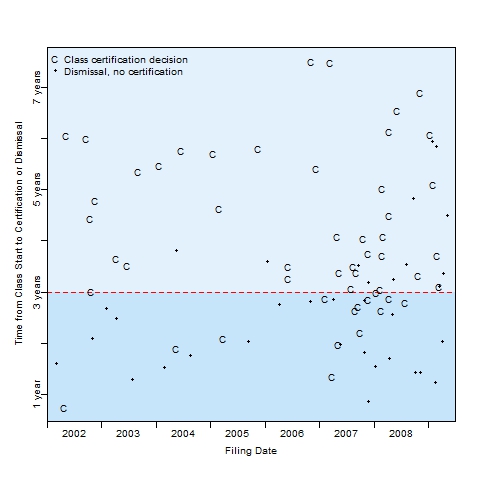
Data on class actions filed during 2002-2009 helped answer these questions.  We first estimated the proportion of cases asserting only Section 11 and 12 claims in which a class certification order occurred after Section 13’s three-year limitations period had expired.  More specifically, we calculated the number of days between the first day of the class period and either:  (i) the date of the district court’s order on a motion for certification (or, in multi-certification-order cases, the last certification order); or (ii) the date of the district court’s order preliminarily certifying a class for purposes of settlement.[3]  The results of these calculations are presented in Figure 1’s scatterplot. 

Figure 1. Time from the Start of the Class Period to a Certification Decision or a Dismissal Without Certification in Cases Asserting Only § 11 or 12 Claims, 2002-2009

fig1_color updated

The results are striking:  Section 13’s three-year limitations period, denoted in Figure 1 as a horizontal dashed line, would have expired prior to a certification decision in 73 percent (38 of 52) of cases that reached a certification decision, and prior to a certification decision in 44 percent (38 of 86) of all filed cases.   To provide more detail on the 52 cases depicted in Figure 1 that reached a certification decision, the three-year limitations period would have expired before an order on a free-standing motion for class certification in 11 of 12 cases reaching such an order.  And that period would have expired in 29 of the 42 cases that reached certification as part of the court’s preliminary approval of a settlement.[4]

Figure 2 presents the results of the same analysis for cases brought under Section 10(b) of the Securities Exchange Act, which is governed by a five-year limitations period.[5]  Data on these cases is taken from a random sample of 500 cases drawn from roughly 1,200 securities class actions filed between 2002 and 2009.[6] The results are again striking: The five-year limitations period that applies to § 10(b) claims would have expired prior to a certification decision in 44 percent (135 out of 307) of cases that reached a certification decision and prior to a certification decision in 27 percent (135 out of 500) of all cases in the sample.[7] 

Figure 2. Time from the Start of the Class Period to a Certification Decision or a Dismissal Without Certification in Cases Asserting § 10(b) Claims, 2002-2009

fig2_color updated


Among the 307 cases in which class certification occurred, 227 classes were certified for the purposes of settlement, and 86 classes were certified in response to free-standing motions to certify. Of the 227 cases certified for settlement purposes, 97 came after the five-year limitations period; of the 86 cases producing an order upon a free-standing motion for certification, 42 came after the limitations period.[8]

Using the above estimates and extrapolating to the roughly 3,200 securities class actions filed since 1997 alleging either Section 11, 12 or 10(b) violations, plaintiffs seeking to preserve their rights without American Pipe’s protective rule would have had to make protective filings in as many as 850 cases.[1][9]  Had even a handful of potential class members in each case done so as the end of the relevant three- or five-year limitations period approached, total filings would have easily numbered in the thousands.

Moreover, as we explained in our brief, these calculations may even underestimate the effect of the Second Circuit’s ruling.  First, a significant number of cases are dismissed without certification after the limitations period expires.  These cases—denoted as dots falling above the dashed line in Figures 1 and 2—could generate protective filings but are not included in the above estimates.  Second, a potential class member’s rights can be cut off by the limitations period because of any defect that is fatal to a class claim, not just denial of certification. Without American Pipe’s protective rule, class members who lack confidence that the lead counsel has cleared all legal hurdles to recovery may make protective filings even after class certification has been granted. Third, if American Pipe’s protective rule does not apply, both lead counsel and defendants will have incentives to drag their heels in the course of pre-trial proceedings in order to cut off potential class members’ opt-out rights.  Finally, the Court’s June 23rd decision in Halliburton strongly suggests that class certification proceedings will likely take longer going forward.  This is because at least some cases will involve dueling expert opinions (including “event studies” using multiple-regression to measure stock-price movement at the time of a false or misleading statement) in order to determine whether the presumption of reliance on which federal securities law rests can be rebutted.  Additional pre-certification proceedings of this sort will likely push more cases above the horizontal dashed lines in Figures 1 and 2, thus increasing the proportion of cases that could generate wasteful protective filings.

Procedure cases often entail difficult trade-offs – for instance, between speed and accuracy in weighing the merits of a case.  In this case, however, there is no benefit to requiring potentially thousands of protective filings in securities class actions. 


[1] Signatories other than me include:  Janet Alexander, Stanford Law School; Stephen Burbank, Penn Law School; Kevin Clermont, Cornell Law School; John Coffee, Columbia Law School; James Cox, Duke Law School; Scott Dodson, Hastings Law School; Jonah Gelbach, Penn Law School; Alexandra Lahav, Connecticut Law School; David Marcus, University of Arizona Law School; Norman Spaulding, Stanford Law School; and Benjamin Spencer, Washington & Lee Law School.


[2]Stanford Securities Litigation Analytics, co-founded by Professor Michael Klausner and Jason Hegland, is a practitioner-focused research group with extensive databases covering securities class actions and SEC enforcement actions.  They are launching a new web tool for practitioners that will allow detailed queries of the database, aggregated statistics based on search results and interactive data visualizations.


[3] Keying this calculation to the start of the class period is consistent with § 13’s language, which states that the limitations period begins to run when the security was “bona fide offered to the public” (§§ 11 and 12(a)(1) claims) or upon the security’s “sale” (§ 12(a)(2) claims). 


[4] Two of the cases in the sample of §§ 11 and 12 cases produced both an order on a motion for certification and a preliminary order approving a class settlement beyond the three-year limitations period, which explains why the numbers reported for cases falling into each category sum to 40 (11 + 29) rather than 38. 


[5] See 28 U.S.C. § 1658(b) (requiring securities fraud cases brought under § 10(b) and Rule 10b-5 to be brought within “5 years after such violation”).


[6] As with the prior analysis, keying the calculation of elapsed time to the start of the class period is consistent with the weight of authority among lower courts that § 1658(b)’s five-year limitations period is subject to an event-accrual rule – i.e., the date of the misrepresentation or the completion of (or commitment to complete) the purchase or sale of the security. See, e.g., McCann v. Hy-Vee, Inc., 663 F.3d 926, 932 (7th Cir. 2011) (holding that the five-year limitations period starts upon misrepresentation); In re Exxon Mobil Corp. Sec. Litig., 500 F.3d 189, 200 (3d Cir. 2007) (same); see also Arnold v. KPMG LLP, 334 Fed. App’x 349, 351 (2d Cir. 2009) (explaining that the limitations period starts when parties commit to purchase or sell).  


[7] The margin of error for these estimates, calculated at the standard 95 percent confidence level, is ±5.5 percent for the first and ±3.9 for the second. In other words, we can be 95 percent confident that the actual proportions lie somewhere between roughly 38 and 50 percent for the first estimate and between 23 and 31 percent for the second.


[8] Four of the cases in the sample of § 10(b) cases produced both an order on a motion for certification and a preliminary order approving a class settlement beyond the five-year limitations period, which explains why the numbers reported for cases falling into each category sum to 139 (42 + 97) rather than 135.


[9] See Alexander Aganin, Cornerstone Research, Securities Class Action Filings: 2013 Year in Review 3 fig.2 (2014), available at http://securities.stanford.edu/research-reports/1996-2013/Cornerstone-Research-Securities-Class-Action-Filings-2013-YIR.pdf (reporting more than 3,200 securities class action lawsuits between 1997 and 2013, an average of nearly 200 per year). The “850 cases” figure was derived by multiplying the 3,200 cases filed since 1997 by the above-reported 27 percent estimate of the proportion of cases in the 500-case sample that reached a certification order after the five-year limitations period.

paIn a long and convoluted opinion befitting the long and convoluted case in which it was entered, Judge David Grine of the Pennsylvania (Centre Country) Court of Common Pleas, applying Pennsylvania law, entered summary judgment for an excess D&O insurer, holding that the excess insurer’s payment obligation had not been triggered due to the insolvency of an underlying excess insurer and because covered defense expenses and settlement amounts were less than the amount of the underlying insurance.


In a nearly two-decade saga growing out of a specialty medical service provider’s alleged over-billing, the Court rejected the plaintiff directors and officers’ argument that settlement amounts funded by the sale of related medical practices — that were neither subsidiaries of the named insured nor additional named insureds under the policy — should be taken into account in determining whether the amount of the plaintiffs’ loss reached the excess insurer’s limit.


A copy of the Court’s June 30, 2014 opinion can be found here.


Background 

EquiMed was a specialty medical services company providing services to radiation oncologists. In 1996, EquiMed was named for the first time as a defendant in an existing qui tam action that had first begun in 1995. There were numerous other defendants in the action, which involved alleged over-billing. In 1998, the U.S. government intervened in the qui tam action. In late 1999 and early 2000, the various defendants reached an agreement to settle the qui tam action, but in February 2000, an involuntary bankruptcy petition was filed against EquiMed. Further settlement negotiations ensued. The ultimate settlement of the qui tam action involved a series of payments by or on behalf of a number of different parties, including a number of medical practice groups that were neither subsidiaries of EquiMed nor additional named insureds under the relevant D&O insurance program.


At the time that the qui tam action was amended to include EquiMed as an additional defendant, EquiMed had a program of D&O insurance that consisted of a $5 million layer of primary insurance, a $5 million first layer of excess insurance, and a $10 million second layer of excess insurance. The first excess layer was provided by Reliance National, which was declared insolvent and went into liquidation on October 3, 2001.


EquiMed submitted the qui tam action to its D&O insurers as a claim. The D&O insurers denied coverage for the claim based on their policies’ respective prior and pending litigation exclusions, in reliance on the fact that the qui tam action had initially been filed before the prior and pending litigation date.  In May 1999, EquiMed filed a coverage lawsuit against the primary insurer and against Reliance National seeking an injunction to force the insurers to pay its defense cost in the qui tam litigation. The second level excess insurer was not a party to this prior coverage lawsuit. The court in the prior coverage lawsuit held that the primary insurer’s prior and pending litigation exclusion did not preclude coverage for the defense costs incurred in the qui tam action.


Three former directors and officers of EquiMed subsequently filed a separate insurance coverage action against the second level excess insurer, seeking reimbursement for the defense expenses and settlement amounts that had not been paid by the primary insurer. The plaintiffs asserted claims for breach of contract and for bad faith. The parties moved for summary judgment.


The second level excess insurer’s policy specified that coverage under its policy did not attach until all of the underlying insurance “has been exhausted solely as a result of actual payment or payment in fact of losses of all applicable Underlying Insurance limits.”


The June 30 Opinion 

In arguing that its payment obligation had not been triggered, the second level excess insurer (hereafter the excess insurer) made two arguments: first, the excess insurer argued that due to Reliance National’s insolvency, the underlying limits had not been exhausted by payment of loss; and second, and in any event, that the amounts the insureds incurred by way of defense and settlement were less than the $10 million, the amount of the underlying insurance.  The Court agreed with both of these arguments.


First, based on the Second Circuit’s June 2013 opinion in Ali v. Federal Insurance Company (about which refer here), the facts of which the Court said were “almost identical to the case at bar,” the Court agreed that, due to Reliance National’s insolvency,  the excess insurer’s payment obligation had not been triggered. In Ali, the Second Circuit held that excess D&O insurance is not triggered even if losses exceed the amount of the underlying insurance, where the underlying amounts have not been paid due to the insolvency of underlying insurers. The Court said that it is “persuaded that the holding in Ali should apply to the case at bar.”


The Court also agreed with the excess insurer that the plaintiffs “are unable to show the required $10 million actual loss, and as a result, Defendants’ duty to indemnify on the claim was never triggered.” The record showed that the primary insurer had paid a total of $4.4 million in defense and indemnity. The excess insurer argued that this amount was the extent of the plaintiffs’ total loss. The plaintiffs, in turn, argued that various other amounts contributed to the qui tam action settlement should be attributed to the plaintiffs for purposes of calculating their actual loss.


The Court rejected the plaintiffs’ arguments to incorporate these additional amounts. First, the Court, citing with approval an opinion from a New York appellate court, held that the payment of a settlement amount in a qui tam action “established unjust enrichment for the purposes of the public policy against insuring against the risk of being ordered to return money or property that has been wrongfully acquired.”


Second, the Court rejected the plaintiffs’ argument that their total loss included amounts contributed toward the qui tam settlements based on the sale of various medical practices that were 100% owned by one of the plaintiffs, Dr. Douglass Colkit. These medical practices were not subsidiaries of EquiMed and were not named insureds in the D&O insurance policies. However, the various medical practices had been defendants in their own name in the qui tam action.  Dr. Colkit had argued that he had been forced to sell the practices in order to fund the settlement. However, the Court ruled that the “payment of funds resulting from their liquidation to the qui tam settlement should be attributed to themselves as defendants, not to the Plaintiffs.”


Third, the Court rejected the argument that amounts of government medical payments the U.S. government had withheld as part of the qui tam settlement were attributable to the plaintiffs. These amounts were “owed to the medical practices, which were themselves defendants in the qui tam action and subsequent settlement,” and are therefore “rightfully attributed to the entities themselves.”


Even certain additional unreimbursed defense expenses, even if taken into account and combined with the $4.4 million paid by the primary insurer “falls short, by almost half, of the amount required to trigger a duty for Defendants to indemnify plaintiffs under the Policy.”


The Court also found that, while certain of the plaintiffs’ allegations stated a claim for bad faith, the plaintiffs’ bad faith claims were time-barred.


Discussion 

It is astonishing to me that there are still cases out there working their way through the system that are affected by the insolvency and liquidation of Reliance National, which went bust in 2001. The Reliance insolvency seems like so much ancient history. If nothing else, this case is a reminder that the most important criterion in choosing an insurer is financial solvency. When an insurer becomes insolvent and goes into liquidation, the mess can be enormous and it can take years to clean up, as this case shows.  


The Court’s holding that the due to the insolvency of the underlying insurer the excess insurer’s payment obligations were not triggered is consistent with the Second Circuit’s holding in the Ali case, which also involved a gap in coverage created by the insolvency of Reliance. In light of the Court’s adoption of the Second Circuit’s holding in Ali, the other parts of the Court’s analysis that the excess insurer’s payment obligations had not been triggered arguably are superfluous. But the Court’s conclusion that the plaintiffs’ losses did not amount to $10 million has some interesting components.


The Court’s holding, made in reliance on a prior New York case, that the settlement of a qui tam action represents the disgorgement of an ill-gotten gain of which it would be against public policy to insure is interesting. The plaintiffs had argued, understandably enough, that because the qui tam action had been settled, there had been no findings of fact that the gains were ill-gotten or improper. The Court cited the New York case for the proposition that the settlement “was essentially equivalent to a determination, reached through agreement of the parties, that the plaintiffs had been unjustly enriched” and that the plaintiffs “made restitution by way of settlement.”


I am sure I am not the only one that finds this not entirely convincing. Parties settle cases for all kinds reasons – for example, a party might settle a qui tam action because one of its excess D&O insurers went insolvent and the other excess insurer was denying coverage and the only way for the party to avoid ruinous defense expenses was to settle the case. Settlements typically represent only the compromise of disputed claims. In the absence of express admissions, the Court’s conclusion that the settlement is “essentially equivalent to a determination” and that the amounts paid in settlement represented “restitution” seems to me to be speculative.


I can certainly see how the Court concluded that the amounts paid in settlement upon sale of the unrelated medical practices represented a settlement of those separate medical practices’ potential liabilities in the qui tam action. However, I can also see Dr. Colkit’s argument that he sold the medical practices, as he might sell any other asset, in order to realize sufficient funds to settle his own potential liability. There may have been more in the record in this case, but I couldn’t find anything in the Court’s opinion to substantiate conclusively that the proceeds of the medical practices’ sale were paid in settlement of the medical practices’ potential liabilities and not paid in settlement of Dr. Colkit’s potential liabilities, other than the Court’s observation that the medical practices had been named as defendants in the qui tam action.


In any event, it may be that this long-running story has finally reached its end. However, the plaintiffs have the option of appealing. Given the history of this case, the possibility that there may yet be further proceedings in this case seems likely.


Special thanks to a loyal reader for sending me a copy of this opinion.